
The modern digital landscape is characterized by rapid technological changes and an increasingly sophisticated cyberthreat landscape. Organizations face the complex challenge of proving compliance with an increasing number of regulations while showing a sustained commitment to digital trust. At the same time, stakeholders are demanding increased transparency and accountability from organizations in how they handle, process, and secure information.
To overcome these hurdles, enterprises must accept that they can no longer view compliance as a mere box-checking exercise that earns them a badge of honor. The real shift is about moving beyond static control environments toward a model where compliance actively contributes to organizational trust, risk mitigation, and resilience. What differentiates this nexus from conventional compliance approaches is its focus on outcomes, not merely evidence. It is about embedding compliance into enterprise-wide governance, decision making, and risk management processes, ensuring that regulatory adherence is aligned with ethical data use, proactive risk identification, transparent operations, and continuous stakeholder engagement.
Organizations can leverage the trust–compliance nexus to transform compliance from a regulatory burden into a strategic enabler of digital trust and resilience.
The Traditional Approach
Many organizations have historically viewed compliance as a regulatory burden to fulfill. The primary drivers of compliance were avoiding fines and demonstrating adherence to regulatory requirements. The problem with this approach is that it is reactive, documentation-heavy, and decoupled from business operations. While such an approach may meet the minimum baseline of regulatory requirements, it fails to truly capture the spirit of resilience and trust necessary in the modern digital world.
This form of compliance is transactional and not strategic. The focus is on checklists, audit programs, and spreadsheets of controls. Risk alignment and stakeholder transparency are often secondary considerations, if considered at all. Additionally, compliance is often siloed from operations, business, and cybersecurity functions, limiting their ability to provide proactive input into system designs and controls or influence change. The result is an environment that might comply with various certifications but does not embody them.
The 2017 Equifax data breach is a prime example of such an environment.1 Despite compliance audits flagging poor security controls and an absence of patching, Equifax failed to repair these conditions. This resulted in a massive data breach that compromised the sensitive information of more than 140 million individuals. Compliance controls were present, but their lack of alignment with the true risk exposure meant they failed to create the culture of digital trust needed in such a sensitive environment.
Equifax’s breach was merely one instance of many where compliance and digital trust did not align. Unfortunately, this dynamic is observable across industries. Organizations often confuse being audit-ready with being secure or trustworthy. Complacency can devastate an enterprise that thinks meeting the minimum requirements is sufficient, while cyberthreats become more sophisticated and deadly every day.
This gap is becoming increasingly challenging as stakeholders and regulators grow more demanding in the current threat landscape. A one-time compliance check is no longer sufficient; organizations must demonstrate ongoing monitoring and proactive governance to foster trust with stakeholders.
While compliance remains a crucial function, organizations must recognize that the traditional approach is insufficient for fostering a culture of trust and readiness. Instead, there are strategies that can empower organizations to move beyond simple checkbox compliance and toward a more integrated, dynamic approach. When adopted effectively, compliance has the potential to become an engine of trust and value rather than a necessary burden.
The Importance of Digital Trust
The traditional compliance approach is no longer sufficient for customers, investors, and regulators. Instead, digital trust has become a key metric for determining how much confidence stakeholders should place in an organization. The term is no longer a brand buzzword. Organizations must earn digital trust by consistently displaying transparency and ethics in their handling of data, technology, and risk management.
The need for digital trust has arisen due to several factors:
- Cyberthreats have escalated in both frequency and scope of damage. As high-profile data breaches and supply chain attacks increasingly make headline news, regulators and stakeholders are no longer satisfied with compliance-based reports that provide only a point-in-time assessment of controls.
- The regulatory environment has evolved from passive enforcement to active monitoring and supervision. In addition to security controls, regulators increasingly focus on accountability, transparency, and risk-based approaches in an organization’s business practices. Regulations such as the EU Digital Operational Resilience Act (DORA), NIS2 Directive, and evolving EU General Data Protection Regulation (GDPR) are no longer limited to IT controls or data protection; they require operational resilience, third-party oversight, and continuous monitoring.2
- Customers have increased their scrutiny of how organizations store and protect their data while meeting ethical and social expectations. Transparency and ethical practices have thus become a competitive advantage and differentiator.
- The C-suite is becoming increasingly aware of the importance of environmental, social, and governance (ESG) issues. Technologies such as AI are being assessed for their potential benefits; meanwhile, concerns are being raised related to algorithmic fairness, bias, and ethical data usage. Failing to take responsibility accordingly can lead to regulatory penalties and reputational damage.
As a result, organizations are reevaluating their approach to compliance. Instead of looking at it as a set of static requirements, compliance is now treated as a dynamic system that fosters digital trust and resilience. Enterprises must understand that trust is cumulative; it is established through transparency in data handling, consistency in security practices, openness in reporting, and alignment with values beyond regulatory requirements.
Compliance and trust have converged. This nexus provides organizations with a powerful opportunity to reshape compliance as a tool for long-term resilience and stakeholder value.
The Digital Trust–Compliance Nexus
As regulatory demands continue to rise, a new understanding has developed: Compliance and digital trust are not separate functions—they are interconnected. Compliance serves as a strategic enabler of digital trust. By embracing this shift in mindset, organizations can enhance stakeholder confidence and strengthen their resilience.
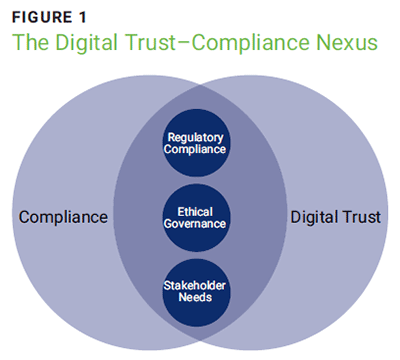 The intersection of regulatory compliance, ethical governance, and stakeholder needs forms the digital trust–compliance nexus (figure 1).
To understand how this nexus works, consider each concept in detail:
- Compliance refers to an organization’s capability to meet legal, regulatory, and contractual obligations. It typically focuses on implementing policies, procedures, audits, and documentation.
- In comparison, digital trust is broader and covers an organization's ability to act responsibly, protect data, and maintain transparency and accountability within digital activities. When compliance is approached proactively, it lays the groundwork for building digital trust.
The connection between digital trust principles and compliance is evident in the EU GDPR. The regulation prioritizes transparency, consent, user control, and accountability regarding personal data, with its core principles aligning closely with the foundations of digital trust. Organizations that adopt the GDPR not merely to pass audits but to integrate privacy by design into their systems may be rewarded with enhanced customer trust and a competitive edge.
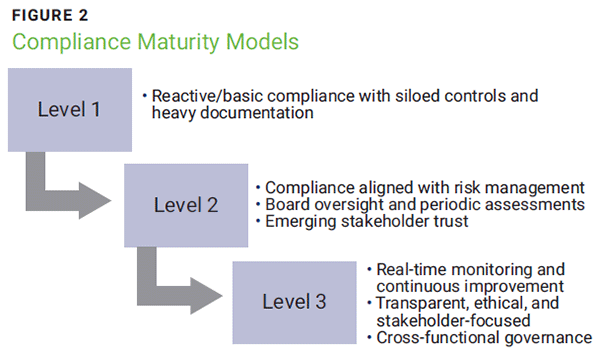
In this case, compliance is no longer merely about avoiding fines but about respecting user rights and data ethics. A helpful way to conceptualize the trust–compliance relationship is through the lens of maturity models. Organizations at the lower end of the maturity scale typically treat compliance as a narrow legal obligation. Controls are implemented to meet specific requirements, and integration with broader risk or business functions is limited. At this level, digital trust is minimal because stakeholders consider the organization to be doing the bare minimum.
At the next level, compliance is integrated into risk management, with periodic assessments, board oversight, and policy alignment. Digital trust begins to emerge as transparency and consistency improve. At the highest level of maturity, compliance is embedded into enterprise strategy to include real-time monitoring, cross-functional collaboration, ethical governance, and stakeholder engagement. Here, compliance is a mechanism for trust-building and value creation. Figure 2 is a visual representation of this maturity journey.
Another aspect of the compliance–trust nexus is internal auditing, where organizations that implement continuous control monitoring (CCM) improve their audit readiness while gaining insights into process and control failures. As a result, they are able to engage proactively with stakeholders, reinforcing a culture of transparency and ethics.
Building a Compliance Strategy Grounded in Digital Trust
Achieving the integration of compliance and digital trust, while very much possible, is not without its challenges. Compliance teams are often under-resourced, siloed, or overly focused on documentation. Bridging the gap requires leadership buy-in, cultural change, and better collaboration across departments, particularly between compliance, risk, IT, cybersecurity, and legal teams. It also requires a shift in mindset: Compliance is not a necessary evil but a strategic asset when aligned with trust-building goals.
At the heart of this evolution is the understanding that resilience and digital trust are outcomes, not just processes. They are built through systems adaptable to emerging risk, transparent in their operations, and grounded in governance that spans technical, legal, ethical, and cultural dimensions. Compliance, when treated as a static checklist, cannot deliver this. However, when integrated into enterprise-wide resilience planning, it becomes a powerful catalyst for operational integrity and stakeholder confidence.
There are several key pillars organizations should consider when building out this framework.
Governance and Culture
Resilient organizations treat compliance not as a standalone function but as an integrated part of enterprise governance. This starts at the top. Boards and executives must recognize that compliance contributes to more than just legal defense—it underpins brand equity, customer loyalty, and market credibility.
To support this shift:
- Appoint a chief trust or resilience officer or elevate the chief information security officer (CISO), chief compliance officer (CCO), or data protection officer (DPO) roles to have cross-functional oversight.
- Embed compliance into enterprise risk management (ERM), strategy, and digital transformation efforts.
- Establish a trust and compliance committee with representatives of legal, risk, IT, cybersecurity, privacy, and business operations.
- Foster a culture of compliance-as-craft, where employees understand that meeting obligations is not about "not getting caught," but about doing the right thing even when no one is there to see it. Consider an example: An employee in a customer support role receives a request for customer data from an external partner. In a checkbox-driven compliance culture, the employee might simply provide the data if no explicit rule prohibits it. But in a compliance-as-craft culture, the employee would pause, verify whether data sharing aligns with customer consent and organizational policy, and escalate the request for review if necessary.
Governance maturity also involves continuous education at the leadership level. To make informed and future-facing decisions, boards must understand cyberrisk, AI ethics, and privacy principles at a deep level. This includes but is not limited to understanding the financial and reputational impact of cyberrisk; the regulatory and ethical considerations tied to AI adoption (such as bias, explainability, and algorithmic accountability); and the operational implications of privacy regulations such as GDPR and global cross-border data transfer rules. By strengthening their fluency in these areas, boards can more effectively oversee risk, set informed strategy, and fulfill their fiduciary responsibilities in today’s complex digital environment.
Data Life Cycle
Data lies at the heart of compliance and digital trust, with security controls only forming a small portion of its governance. Organizations must foster a data stewardship mindset that promotes transparency, accuracy, security, and ethical use across the entire data life cycle.
This means:
- Conducting data classification and mapping exercises to understand where data resides, who has access to it, and how it flows between systems and jurisdictions
- Applying privacy by design principles across product and system development life cycles
- Implementing automated data retention and deletion controls to comply with laws (e.g., the right to be forgotten)
- Leveraging data provenance and audit trails to provide evidence of lawful and ethical data handling
Critically, privacy programs should go beyond regulation and provide value through transparency dashboards, user-controlled privacy settings, and proactive disclosure of data use policies to boost compliance and customer trust.
Third-Party and Supply Chain Assurance
Resilience is only as strong as the weakest link in a digital ecosystem. In today’s connected world, organizations depend on vendors, cloud providers, AI platforms, and software as a service (SaaS) tools, all of which may expose them to compliance failures or trust breaches.
To mitigate these risk factors:
- Implement a third-party due diligence program that consists of regular assessments.
- Ensure that contracts include:
- Data residency and processing location disclosures
- Breach notification timelines
- Audit rights and compliance certifications
- AI governance responsibilities, including ethical use and explainability
- Classify vendors based on risk tiers and apply controls proportionately. For example, a payroll processor handling personally identifiable information (PII) deserves more scrutiny than a design software vendor.
- Monitor fourth-party risk (which occurs when vendors subcontract part of an organization’s services without its knowledge).
Supply chain assurance is especially important in regulated industries such as finance, healthcare, and critical infrastructure, where regulators increasingly expect end-to-end compliance visibility.
Measurement, Monitoring, and Continuous Improvement
A trust-centered compliance program must be measurable. Without meaningful metrics, knowing whether systems are legally compliant, operationally effective, and trustworthy is impossible.
Recommended practices include:
- Develop a set of trust and resilience key performance indicators (KPIs), such as:
- Mean time to detect (MTTD)/mean time to respond (MTTR) to incidents
- Percentage of third-party vendors with valid certifications
- Data subject request response times
- Number of privacy complaints or breaches reported
- Implement compliance dashboards that are visible to both executives and functional leaders.
- To stay current and responsive, use tools such as CCM, compliance analytics, and regulatory intelligence feeds.
- Integrate feedback loops. Regulatory updates, audit findings, and user feedback should all inform ongoing compliance enhancements
Measurement is also essential to demonstrating accountability. Regulators increasingly want to see that not only are controls in place, but they are effective, continuously improved, and regularly tested.
Building a trust-centered compliance model means shifting from a defensive, audit-driven posture to a proactive, risk-informed, and stakeholder-aligned one.Leveraging Technology and Standards
Technology can be a force multiplier in scaling compliance and trust. Automation, AI, and data analytics can streamline control testing, monitoring, and documentation, allowing compliance teams to focus on governance rather than paperwork.
Organizations should:
- Use governance, risk, and compliance (GRC) platforms to automate risk and compliance workflows.
- Deploy AI governance tools to monitor algorithmic behavior, explainability, and fairness.
- Leverage identity and access management (IAM), data loss prevention (DLP), and security information and event management (SIEM) platforms to link technical enforcement to compliance controls.
- Align with evolving standards such as:3
- ISACA’s Digital Trust Ecosystem Framework (DTEF)
- The US National Institute of Standards and Technology (NIST) AI Risk Management Framework
- International Organization for Standardization (ISO)/International Electrotechnical Commission (IEC) 27001 and ISO/IEC 42001
The Future of Compliance
Effectively translating the trust–compliance nexus from a vague concept to a practice requires a coordinated strategy. For many organizations, the initial challenge is acknowledging that their existing compliance programs, although functional, may not be adequately designed to inspire trust or adapt to a dynamic risk environment. Building a trust-centered compliance model means shifting from a defensive, audit-driven posture to a proactive, risk-informed, and stakeholder-aligned one.
Forward-thinking organizations view compliance not as a mere defensive measure, but as a foundation for competitive advantage. These organizations integrate compliance into the overall enterprise strategy, aligning it with other functions such as risk management and technology governance. This approach reinforces cultural values such as transparency, accountability, and ethical decision making. By doing so, organizations both reduce the risk of non-compliance and create agile, credible, and future-ready systems.
The path forward is clear. Compliance cannot remain a siloed, backward-looking function. It must become an integrated, adaptive, and strategic capability that aligns with the organization’s values, anticipates change, and strengthens resilience at every level. By embracing this shift, organizations can ensure that they are compliant and trustworthy. In the digital era, trust is the ultimate benchmark of long-term success.
Endnotes
1 United States Senate, How Equifax Neglected Cybersecurity and Suffered a Devastating Data Breach, USA, 2019
2 European Insurance and Occupational Pensions Authority, Digital Operational Resilience Act (DORA), European Union, 2025; European Commission, NIS2 Directive: New Rules on Cybersecurity of Network and Information Systems, European Union, 2024; Regulation (EU) 2016/679 of the European Parliament and of the Council of 27 April 2016 on the protection of natural persons with regard to the processing of personal data and on the free movement of such data, and repealing Directive 95/46/EC (General Data Protection Regulation [GDPR])
3 ISACA®, The Digital Trust Ecosystem Framework, 2024; National Institute of Standards and Technology (NIST), AI Risk Management Framework, 2023, USA; International Organization for Standardization (ISO) and International Electrotechnical Commission (IEC), Joint Technical Committee on Information Technology (ISO/IEC JTC 1), ISO/IEC 27001:2022 Information security, cybersecurity and privacy protection—Information security management systems—Requirements, Edition 3, 2022; ISO/IEC JTC 1, ISO/IEC 42001:2023 Information technology—Artificial intelligence—Management system, Edition 1, 2023
PRANJAL SHARMA
Is a senior software engineer with more than 13 years of experience in cloud computing, distributed systems, artificial intelligence (AI), machine learning (ML), cybersecurity, and zero trust security. He has a diverse background in technology development and sales. Sharma has contributed to multiple Institute of Electrical and Electronics Engineers (IEEE) conferences as an author, publication reviewer, and chair, particularly in the fields of cybersecurity and cloud computing. His expertise spans a wide range of technologies, including advanced network security protocols, scalable cloud solutions, and data privacy frameworks. He is currently focused on implementing zero trust architectures to enhance security in distributed environments and working toward building resilient systems for organizations adapting to modern security challenges. Sharma is also the inventor of a pending patent related to cloud-based security architecture.