
Modern software moves too fast, spans too many languages, and hides behind too many abstractions for rule-only tools to keep up. The question facing every chief information security officer (CISO) and chief architect is no longer whether to run static application security testing (SAST) but how to combine SAST’s guarantees with artificial intelligence (AI) to find vulnerabilities before attackers do.
Static analysis, the systematic evaluation of source code without program execution, is indispensable in uncovering latent defects, enforcing coding standards, and identifying security vulnerabilities prior to deployment. The growing complexity and heterogeneity of software systems are continually expanding the domain and difficulty of static analysis.
The significance of static analysis extends beyond academic interest. Enterprises worldwide rely on SAST tools to identify vulnerabilities before deployment, and industry reports forecast continued market growth through 2026.1 Understanding the historical context, current limitations, and future potential of these technologies is crucial for security professionals, software architects, and organizational decision makers.
Historical Foundations of SAST
The mathematical foundations of static analysis can be traced to Patrick and Radhia Cousot’s seminal 1977 work on abstract interpretation.2 Their framework provided a rigorous mathematical basis for approximating program semantics without execution, establishing the theoretical underpinnings for all subsequent static analysis techniques. Abstract interpretation formalized the concept of conservative approximation—analyzing program behavior at various levels of abstraction while guaranteeing correctness.
Building on this theoretical foundation, Stephen Johnson developed Lint for Unix in 1978. Originally conceived to identify suspicious C-language constructs during the development of the Yet Another Compiler Compiler (YACC) parser, Lint represented the first practical implementation of automated source code analysis. Johnson’s tool addressed portability issues arising from Unix’s migration to 32.bit architectures, establishing the precedent for using static analysis to prevent runtime errors.3
The transition from quality assurance to security-focused analysis occurred gradually throughout the 1990s as internet adoption accelerated. Buffer overflow vulnerabilities, prominently featured in Computer Emergency Response Team (CERT) advisories throughout the decade, demonstrated the critical need for automated security analysis. Academic research programs at institutions such as Stanford and the University of California at Berkeley (USA) developed prototype tools that applied static analysis techniques specifically to vulnerability detection.
The Commercial Maturation Era
By the turn of the century, experimental prototypes and academic proofs of concept had ripened into something both investors and security-conscious enterprises were ready to bet on. Capital, compiler talent, and a rising tide of costly vulnerabilities converged to pull static analysis out of the lab and into build pipelines. What followed was a burst of entrepreneurial energy and, soon after, the emergence of organizing frameworks that hardened SAST into a market with durable expectations.
SAST Startup Boom
The early 2000s heralded a period of unprecedented commercial advancement in static analysis characterized by a thriving ecosystem of innovative startups and significant venture capital investment. This era marked the transformation of static analysis from academic research to industrial-grade security solutions, establishing SAST as a distinct market category.
This period witnessed the emergence of numerous enterprises, including Fortify, Coverity, and Ounce Labs, that collectively validated the commercial viability of automated security analysis. These entities introduced sophisticated implementations of taint analysis, control flow techniques, and comprehensive vulnerability detection systems that could operate at enterprise scale. IBM acquired Ounce Labs in 2009, HP announced its acquisition of Fortify in 2010, and Synopsys completed its acquisition of Coverity in 2014—events that underscored the market’s maturation.4
Concurrently, the open-source ecosystem flourished with tools such as FindBugs (later SpotBugs), PMD, and Checkstyle for Java development, alongside security-focused tools including RATS, Flawfinder, and ITS4 for C/C++ analysis. This dual track of commercial and open source development created a vibrant, competitive environment that drove rapid technological advancement and widespread adoption across market segments.
Framework Standardization
In parallel with commercial development, industry frameworks emerged to standardize secure development practices. The Open Software Assurance Maturity Model (OpenSAMM), introduced in 2009 by Pravir Chandra and later donated to the Open Worldwide Application Security Project (OWASP), provided enterprises with structured guidance for implementing security programs.5 Similarly, the Building Security in Maturity Model (BSIMM), developed by Gary McGraw, Sammy Migues, and Brian Chess in 2009, offered a descriptive framework based on real-world security initiatives across major enterprises.6
These frameworks legitimized static analysis as a core component of enterprise security programs, providing measurement criteria and implementation roadmaps that accelerated adoption across industries and established the foundation for modern DevSecOps practices.
Modern DevSecOps practices employ a composite control plane: static analysis, structured design review, continuous integration/continuous delivery (CI/CD) enforcement points, dynamic application security testing (DAST), and software bill of materials (SBOM)-centered supply chain transparency, reinforced by threat modeling, dependency governance, secrets management, telemetry, and integrity gating. Figure 1 presents a simplified phase-oriented view of representative controls rather than an exhaustive taxonomy.
Figure 1—Secure-by-Design Controls by Software Development Life Cycle (SDLC) Phase
| SDLC Phase | Examples of Secure by Design Controls |
|---|---|
| Plan | Threat modeling, abuse cases, security nonfunctional requirements |
| Build | SAST in CI, secure coding standards, secrets scanning |
| Test | DAST on staging, fuzzing, dependency and pipeline scanning |
| Release | SBOM, security gate checks, change approvals |
| Operate | Runtime protection, monitoring, incident response runbooks |
Architecture of Traditional Static Analysis
Traditional static analysis operates through a systematic multistage process that transforms source code into analyzable representations and applies various analytical techniques to identify potential vulnerabilities.
Core Processing Pipeline
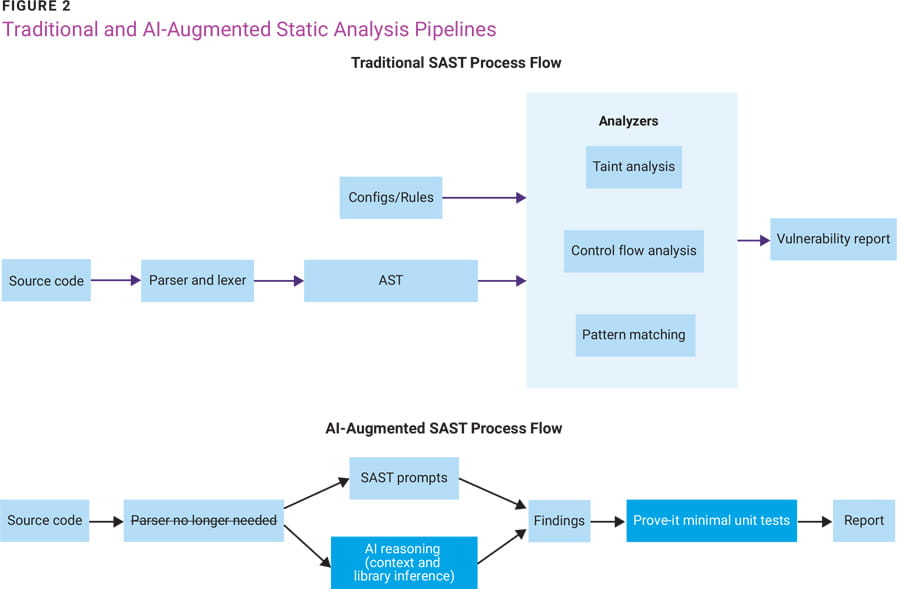
Classic static analyzers follow a staged pipeline. Source code is tokenized and parsed into an abstract syntax tree (AST). From the AST, the tool derives control flow graphs (possible execution paths) and data flow graphs (how values propagate). Analyses and rules operate on these structures to detect risky patterns and emit findings for review. AI-augmented analyses share a similar flow but differ in how they reason about context. Figure 2 shows the traditional pipeline alongside an AI-augmented variant for comparison.
Traditional SAST Analytical Techniques
There are three techniques that constitute traditional SAST:
- Taint analysis is the most significant technical advancement in security-focused static analysis. It tracks the flow of untrusted data from entry points (sources) through program transformations to potentially dangerous operations (sinks). Effective taint analysis requires comprehensive modeling of data transformations and library behaviors to maintain accuracy across complex program paths.
- Control flow analysis examines possible execution sequences to identify unreachable code and assess the feasibility of potential vulnerability exploitationpaths. Advanced implementations employ symbolicexecution techniques to reason about program behavior under different input conditions.
- Pattern matching identifies known vulnerabilitypatterns through syntactic analysis. However, thisapproach typically generates higher false-positiverates compared to semantic analysis techniques.
Taken together, these three techniques form a robust foundation but leave important gaps that modern software trends expose.
Contemporary Challenges
These architectural strengths worked well when codebases were smaller, languages fewer, and frameworks thinner. Modern development has stretched original assumptions: Language diversity multiplies maintenance, dynamic features erode precision, and layers of third party abstractions conceal the flows that need to be seen the most. Grasping these pressures clarifies the problem space newer AI-assistedtechniques are now being asked to relieve.
Language Ecosystem Explosion
The modern programming landscape has undergone a dramatic transformation since the formative years of SAST. Early tools concentrated on only a few mainstream languages such as C and Java, but today there are dozens of actively used languages, each
with unique syntax and semantics.
This language diversity has generated a critical scalability issue for rule-based tools. Dedicated parser and rule development is required for each language, challenging SAST vendors to keep pace. GitHub data shows that by 2024, Python surpassedJavaScript as the most widely used language globally; Java leaped from seventh place in 2008 to second place in 2015, largely due to trends such as adoption by Android devices and a number of enterprises.7 Meanwhile, emerging languages such as Go, Rust, and TypeScript are rapidly gaining traction. Each new language multiplies the development and maintenance required for comprehensive coverage, stretching traditional SAST resources to the limit.
Dynamic Language Challenges
In dynamic or weakly typed languages (e.g., JavaScript, Python, Ruby), critical semantic information, such as the concrete type of a value, the class type of an object, and the target of a method call, is often decided only at runtime. Without reliablestatic type information, analyzers must approximate.
That approximation quickly erodes precision. Late binding and dynamic dispatch obscure call targets; duck typing and monkey patching change object behavior after analysis; and reflection, runtime evaluation (e.g., “eval()”), and metaprogramming can synthesize code paths the analyzer never sees.
Dynamic imports and dependency injection further fragment the program view, and string-built queries or routes make source-to-sink reasoning brittle.
Faced with these constructs, a static tool is forced into an uncomfortable trade-off: Be conservative and identify many potential issues (raising noise) or be aggressive and miss real flows (reducing recall).Practical mitigation methods include adopting optional typing (TypeScript, Python type hints), supplying library stubs and taint models, constraining highly dynamic features in secure coding standards, and enriching analysis with evidence from tests or runtime traces. AI assistance can help by inferring likely types and intent from names and usage, narrowing the search space where static information is unavailable.
Abstraction and Library Dependencies
Modern applications heavily rely on third-party libraries and frameworks, creating a fundamentalblind spot for traditional SAST tools. When developers invoke library functions, the source for these dependencies is often outside the analyzed code base, leaving analyzers unable to infer security
implications without explicit models. For example, without preconfigured rules, systems cannot know whether an object-relational mapper (ORM) call parameterizes queries or a helper preserves taint. This indirection is amplified by abstraction layers—ORMs, cloud software development kits (SDKs), and microservices—that obscure direct code relationships. The proliferation of external dependencies compounds the challenge, as contemporary applications routinely incorporate hundreds of libraries, each potentially adding attacksurfaces that static analyzers cannot fully assess without comprehensive models.
AI-Augmented Code Review
This growing friction has not killed static analysis; it has forced an evolution. AI is now being used to supply the semantic glue—linking calls across opaque frameworks, inferring intent where type information is not available, and prioritizing the handful of flows that actually look exploitable.
What AI Adds
Large language models (LLMs) and related AI technologies address several fundamental limitations of traditional static analysis:
- Language-agnostic learning—Unlike traditional approaches that require handcrafted parsers, AI models learn programming language semantics through training on diverse code bases. Once trained, these models can analyze code in any supported language without additional parser development.
- Semantic understanding—AI models demonstrate a capacity for semantic reasoning that extends beyond syntactic pattern matching. Recent work indicates that transformer-based models can infer programmer intent and identify subtle vulnerability patterns that escape rule-based systems.8
- Contextual reasoning—AI-powered analyzers can maintain context across library boundaries and complex control flows, potentially addressing the library modeling challenges that limit traditional approaches.9
- Customization and extensibility—Traditional SAST is typically extended via language-specific rules and taint models, which are powerful but slow to evolve. AI-assisted analysis introduces a faster layer of customization through prompt templates and repository-aware context. Teams can tailor detection goals (e.g., “flag unparameterized ORM calls” or “surface secrets and outbound calls in the same change”) without waiting for new rule packs. It is good practice to treat prompts like policy (versioned in the source code repository, reviewed via pull request); add seeded test cases; keep prompts about sources/sinks and acceptance criteria concise and explicit; and capture model and version, prompt, and output with the findings for audit.
- Detection accuracy—Recent research provides evidence of AI’s effectiveness in static analysis applications. Studies report that AI-assisted approaches can increase true positives while reducing some false-discovery noise compared to rule-only workflows.10
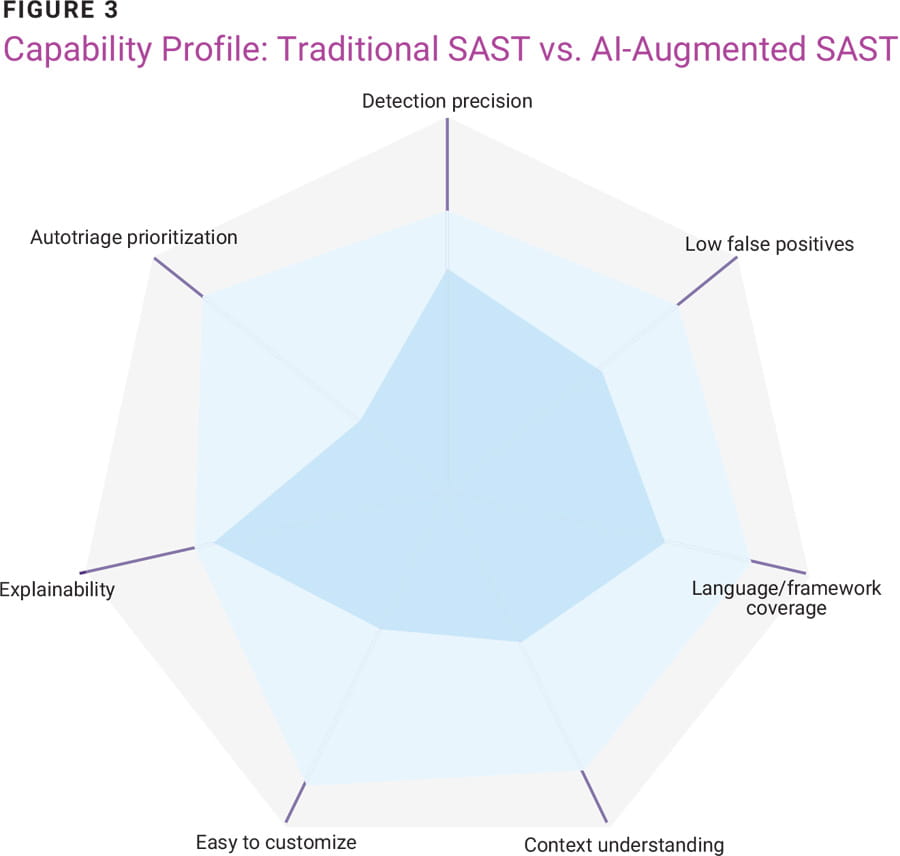
Figure 3 serves as a directional visual aid rather than a precise benchmark. Scores are normalized to a notional 0–5 scale to highlight relative strengths: Traditional engines retain mature explainability and established precision baselines, while AI-assisted workflows extend contextual reasoning, customization velocity, and automated triage. Exact values will vary by toolchain and configuration; the purpose is to frame the discussion, not to assert definitive measurements.
Operating Model, Risk, and Adoption
AI-augmented review is the primary analysis layer. In practice, the AI system reviews pull requests and other high-risk paths, infers intent and data flows across library boundaries, clusters and prioritizesfindings to cut noise, and—when confidence is low or impact is high—drafts a minimal “prove-it” unit or
integration test that runs in an ephemeral sandbox to produce evidence. It is important to encode internal coding standards and security requirements as versioned prompt templates so the system enforces policy, not opinion.
Security-review AI is maturing alongside broader generative AI tooling. Established vendors are adding AI features; newer entrants focus on review. Because claims and capabilities change quickly, it is recommended that users verify current evaluations and pilots before committing to any model.11
Conclusion
Security leaders no longer have the luxury of choosing between precision and speed. A resilient program fuses the provable strengths of static analysis with AI’s semantic reach, uses human judgment as the control system, and measures value in vulnerabilities prevented—not alerts produced. If engineering, audit, and risk are aligned around that outcome, software will be both faster and safer—finally putting defenders back on the offense.
Endnotes
1 Verfified Market Reports, Static Application Security Testing (SAST) Tool Market Size, March 20252 Cousot, P.; Cousot, R.; “Abstract Interpretation: A Unified Lattice Model for Static Analysis of Programs,” Proceedings of POPL, 1977
3 Johnson, S.; Hill, M.; “Lint, a C Program Checker,” Semantic Scholar, 1978
4 Whitney, L.; “IBM Buys Ounce Labs,” CNET, 28 July 2009, Greenberg, A.; “HP to Acquire Fortify Software,” Forbes, 17 August 2010; Synopsys, “Synopsys Completes Coverity Acquisition,” PR Newswire, 25 March 2014
5 OWASP, “OWASP SAMM”
6 Black Duck, “Building Security In Maturity Model (BSIMM)”
7 GitHub, “The State of the Octoverse 2024,” 2024
8 Chapman, P.; Rubio-González, C.; et al.; “Interleaving Static Analysis and LLM Prompting,” SOAP ’24 (Programming Language Design and Implementation Workshop), 2024, ; Yang, Y.; Wen, M.; et al.; “Reducing False Positives of Static Bug Detectors Through Code Representation Learning,” SANER ’24, 2024
9 Chapman, et al., “Interleaving Static Analysis”; Yang, et al., “Reducing False Positives”
10 Chapman, et al., “Interleaving Static Analysis”; Yang, et al., “Reducing False Positives”
11 Snyk, “Snyk Announces Acquisition of DeepCode,” PR Newswire, 23 September 2020; Giannini, S.; Gill, H.; “50% Faster Merge and 50% Fewer Bugs: How CodeRabbit Built Its AI Code Review Agent With Google Cloud Run,” Google Cloud, 22 April 2025
JASON LAU | CISA, CISM, CGEIT, CRISC, AAIA
Is chief information security officer at Crypto.com and a member of the ISACA® Board of Directors.
SAM NG
Is senior vice president for network and application security at Crypto.com.