


Governance, risk, and compliance (GRC) programs with years of documented controls, clean audit histories, and executive sponsorship have been known to quickly fall apart when a key control owner departs the organization. No breach precipitates the failure. No malicious actor is involved. The evidence collection process existed entirely within one person's institutional knowledge, and the program was never designed to survive that person's absence.
This structural weakness is a consequence of how the programs themselves are designed. Governance programs built on manual processes, implicit ownership, and point-in-time evidence collection are inherently fragile. They are dependent on the continuous availability and institutional memory of the individuals who operate them. When those individuals are unavailable, the program degrades. This pattern is among the most common structural failures observed in governance programs operating at scale. And it is not, at its core, a compliance failure. It is an engineering failure, and one that a parallel discipline solved decades ago.
The Design Problem in GRC Programs
Many governance programs in operation today share a foundational design characteristic: they were built to be maintained by people rather than engineered to maintain themselves. Policies are recorded in Word documents and stored on shared drives with no version history. Control ownership is implied by organizational role rather than documented by explicit assignment. Evidence collection occurs in concentrated preaudit preparation windows because no one engineered it to occur any other way. The program appears mature and well-governed until pressure arrives in the form of an audit finding, a regulatory inquiry, or an organizational change. At that point, the gap between what the program documents and what the program does becomes visible and costly.
What Software Engineers Already Know
Software engineering confronted an equivalent problem as development teams grew and systems became more complex. The challenge of managing code across multiple contributors, tracking every change, validating that systems behaved as intended, and ensuring that a single team member's departure did not introduce instability required a fundamentally different approach to how systems were built and maintained.
The response was to engineer resilience into the system itself. Version control made every change trackable, attributable, and reversible.1 Automated testing made it possible to validate system behavior continuously rather than episodically.2 Continuous integration pipelines enforced quality and compliance checks before changes reached production.3 These practices did not merely improve software quality—they transferred institutional knowledge from individual memory into version-controlled artifacts that any qualified team member could access, review, and build upon.
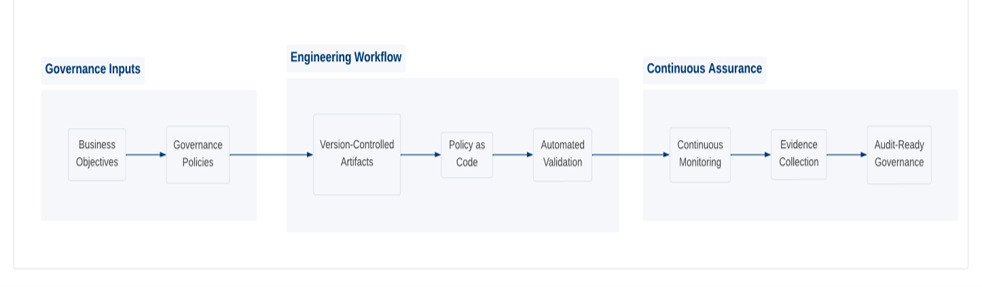
The same logic applies directly to governance program design (figure 1). Applying software engineering practices to GRC program management is increasingly being referred to as Governance as Code (GaC), and its practical expressions are available to any organization willing to make the investment.4
Figure 1—Governance as Code (GaC) Operating Model5
Four Practical Applications of Governance as Code
While Governance as Code is an emerging approach, organizations do not need to redesign their governance programs overnight to begin realizing its benefits. Instead, organizations can incrementally integrate software engineering principles into existing governance processes, improving consistency, traceability, and operational resilience over time. There are 4 practical ways organizations can begin embedding governance directly into engineering workflows:
- Version-controlled policy management—When governance artifacts are stored in a version control system, such as Git, rather than on a shared document drive, every change to a policy or control document is automatically tracked with a timestamp, an author attribution, and a description of the reason for the change. Proposed changes move through a formal review and approval workflow before they are merged into the authoritative version. The audit trail is generated as a natural byproduct of how work is performed rather than as a separate documentation effort. For GRC teams managing multiple policies across multiple regulatory frameworks, this eliminates one of the most persistent audit preparation problems: the inability to demonstrate what changed, when it changed, and whether the change was properly authorized.
- Automated control testing—Tools such as Chef InSpec and Open Policy Agent enable organizations to express control requirements as executable specifications and validate those requirements against actual system configurations on a continuous basis. A control requiring encryption on all production data storage volumes can be tested daily against the actual state of every volume in scope. When a new volume is provisioned without the required encryption configuration, the test fails and an alert is generated within hours rather than at the next scheduled audit cycle. The evidence of each test run is captured automatically, creating a continuous audit record rather than a point-in-time snapshot assembled under deadline pressure.
- Compliance pipeline integration—In software development, a continuous integration/continuous delivery (CI/CD) pipeline runs automated validation checks against every proposed infrastructure change before that change reaches the production environment.6 The same pattern should be applied to governance. With the deployment of a new system, a compliance pipeline can validate that required security controls are properly configured before the system is placed into service. This repositions compliance from a reactive audit function performed after the fact into a proactive design constraint enforced at the point of change.
- Infrastructure as Code (IaC) for governance documentation—Tools such as Terraform and Ansible allow security configurations to be defined in version-controlled specification files and applied consistently across environments. When the configuration specification is the governing document, the gap between what a policy states and what a system does is eliminated by design rather than monitored by exception.
Conclusion
None of these practices require a proprietary GRC platform license. Many of the tools involved are open source and widely available. What they require is a GRC professional who possesses sufficient understanding of both governance requirements and engineering implementation to connect the disciplines effectively.
That combination of governance program depth and engineering fluency represents an emerging skill set that ISACA® professionals are well positioned to develop. The organizations that apply these principles will operate audit functions that validate continuously rather than periodically, maintain evidence as a byproduct of operations rather than a preaudit effort, and build programs that survive personnel changes because institutional knowledge resides in version-controlled artifacts rather than individual memory.
The practitioners who are developing engineering capabilities for governance systems are not simply adapting to a changing field. They are defining the very direction the field will take.
Endnotes
1 Chason, S.; Straub, B.; Pro Git, Apres Open, USA, 2014
2 Beck, K.; Test Driven Development: By Example, Addison-Wesley Professional, USA, 2002
3 Humble, J.; Farley, D.; Continuous Delivery: Reliable Software Releases through Build, Test, and Deployment Automation, Addison-Wesley Professional, USA, 2010
4 Panasyuk, Y.; “Governance as Code: An Innovative Approach to Software Architecture Verification,” Medium, 20 February 2024
5 Author’s illustration of how governance activities are integrated into the software engineering lifecycle through version-controlled artifacts, policy as code, continuous validation, monitoring, and evidence collection.
6 Fowler, M.; “Continuous Integration,” martinFowler, 18 January 2024
Neviar Rawlinson, GRC
Is an IT governance professional specializing in governance, risk, compliance (GRC), cybersecurity, and enterprise change management. She is the founder of GRC Explained, an educational platform dedicated to making governance, cybersecurity, and AI concepts more accessible through practical guidance, training, and community engagement. Her work focuses on modernizing governance programs by applying software engineering principles, automation, and scalable operational practices.