

One of the questions I get asked quite often is, “If I want to move into AI, should I focus on risk, security, or audit first?”
My answer is usually: it depends on where you are in your career today.
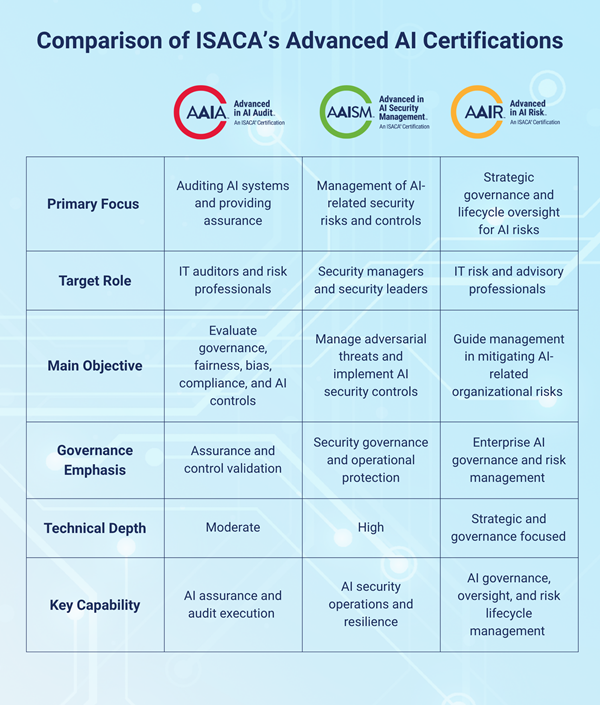
After attaining all three ISACA Advanced AI credentials: Advanced in AI Risk (AAIR), Advanced in AI Security Management (AAISM) and Advanced in AI Audit (AAIA), I realized they are not competing certifications. Instead, they represent three different perspectives that organizations need if they want to adopt AI responsibly.
In fact, they mirror the same challenges I see when working with organizations across governance, cybersecurity, risk management and digital transformation initiatives.
AAIR: Looking at AI Through a Governance and Risk Lens
If someone asked me where to start, I would normally recommend beginning with AI risk and governance.
The reality is that many organizations today are moving faster in AI adoption than in AI governance. Business units are experimenting with Generative AI, developers are integrating AI into applications and executives are exploring AI-driven business opportunities. However, governance frameworks often lag behind.
This is where AAIR provides tremendous value.
What I appreciated most about AAIR is that it focuses on the bigger picture. It helps professionals understand how AI should be governed throughout its lifecycle, from strategy and development to deployment and monitoring.
For risk professionals, GRC practitioners, compliance officers, consultants and governance leaders, AAIR provides the language and framework needed to engage management and boards in meaningful discussions about AI risk.
Rather than asking, “How does the AI model work?”, AAIR encourages professionals to ask:
- Who is accountable for AI decisions?
- What risks could arise from AI usage?
- How do we monitor AI outcomes?
- Are we prepared for regulatory scrutiny?
- Do we have adequate governance over AI initiatives?
In my view, this is why AAIR is such an important foundation. Good governance should come before security controls and certainly before audit reviews.
AAISM: Extending Cybersecurity into the AI Era
For cybersecurity professionals, AI introduces an entirely new set of challenges.
Traditional security programs were designed to protect networks, endpoints, applications and data. AI systems introduce additional concerns that many security teams are only beginning to understand.
During my AAISM journey, one of the biggest takeaways was recognizing how AI changes the threat landscape.
Today we hear about prompt injection, model manipulation, adversarial attacks, data poisoning and model theft. These are not traditional cyber threats, yet they can have significant business impact.
AAISM helped connect familiar cybersecurity concepts with emerging AI-specific risks.
I believe AAISM is particularly valuable for CISOs, security managers, security architects, technology risk professionals and consultants who are advising organizations on AI adoption.
What makes AAISM stand out is its practical focus. It is not just about understanding AI threats—it is about understanding how security governance, security architecture and operational controls need to evolve as AI becomes embedded into business processes.
For security leaders, AI security will soon become as important as cloud security and application security are today.
AAIA: Providing Assurance in an AI-Driven World
Once governance and security are established, organizations eventually need assurance that everything is working as intended.
This is where AAIA comes into the picture.
As auditors, we are often expected to provide independent assurance over governance, controls, compliance and risk management processes. AI is no different.
What I found particularly valuable about AAIA is that it helps bridge the gap between traditional audit methodologies and the unique characteristics of AI systems.
Auditors now need to evaluate questions such as:
- Can AI decisions be explained?
- Is there adequate oversight over model changes?
- How are bias and fairness managed?
- Are AI controls operating effectively?
- Are regulatory obligations being met?
These are not questions that traditional audit programs were originally designed to address.
AAIA equips auditors and assurance professionals with the knowledge needed to evaluate AI governance and controls in a structured and credible manner.
As regulators around the world increase their focus on responsible AI, I believe AI assurance will become one of the fastest-growing areas within the audit profession.
Why All Three Matter
If I had to summarize the three credentials in one sentence:
AAIR helps you understand what needs to be governed.
AAISM helps you understand what needs to be protected.
AAIA helps you determine whether governance and controls are actually working.
Together, they provide a comprehensive view of responsible AI adoption.
From my personal experience, each credential strengthened my understanding of the others. AAIR provided the governance foundation. AAISM expanded my perspective on AI-specific security challenges. AAIA brought everything together through assurance and independent assessment.
Organizations often focus heavily on AI innovation. However, long-term success will depend on something far less glamorous: governance, security and trust.
That is precisely where risk professionals, cybersecurity practitioners and auditors can make the biggest contribution to the AI journey.
Having completed AAIR, AAISM and AAIA, I discovered that the three credentials are not alternatives but instead represent complementary perspectives required for responsible AI governance. While any sequencing of these credentials is perfectly fine, if I had to recommend a starting point, I would suggest aligning the first credential with your current role: AAIR for governance and risk professionals, AAISM for cybersecurity leaders and AAIA for auditors and assurance practitioners.