Introduction
Following the mass adoption of generative artificial intelligence (AI), AI agents have become the center of attention in the quickly evolving AI landscape. Within the next two years, agentic AI is expected to become nearly ubiquitous, with three in four companies using it at least moderately.1
With great opportunity, however, comes great risk. Since AI agents can perceive, reason, and act on their own, how are they secured? Do they know to secure themselves? Indeed, practitioners have reason to be concerned. In July 2026, an agentic AI infiltrated Hugging Face production infrastructure before another AI system was able to detect and flag the intrusion.2 Enterprises are now in the age of AI battling AI. Securing AI agents is crucial to protecting autonomous software from being manipulated to perform unauthorized actions or steal enterprise data, which can lead to financial loss, brand damage, and compliance issues.
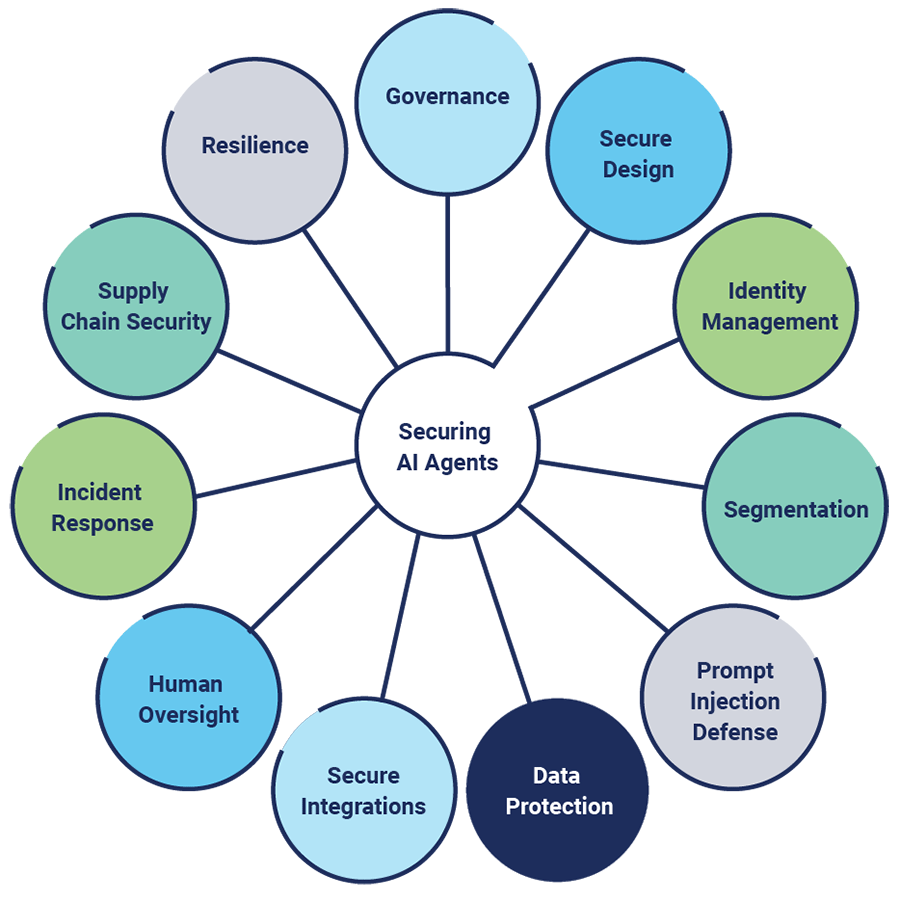
This white paper provides a solid foundation of controls, explains their importance in securing AI agents, and includes a checklist for quickly assessing what areas are missing in an existing program. Figure 1 shows a high-level overview of the topics addressed by the controls. Note that these recommended controls are intended for securing AI agents, not agentic AI specifically.
Figure 1: Overview of Topics
Practice Categories and Controls
The controls for securing AI agents are classified into 11 practice categories. Figure 2 describes each category and its rationale for inclusion.
Figure 2: Practice Categories
| Practice Category | Rationale |
|---|---|
|
Governance, Asset Inventory, and Risk Ownership |
Without asset visibility and ownership, organizations cannot consistently manage agent risk, monitor changes, or respond to incidents. |
|
Secure AI Development, Change Management, and Continuous Assurance |
AI security risk changes continuously across the system life cycle. Many failures are introduced not by the model itself, but by how the AI system is built, deployed, updated, connected to tools, and maintained. |
|
Strong Identity, Authentication, and Authorization |
Compromise of an overprivileged agent identity can enable rapid unauthorized actions across connected systems. |
|
Network Segmentation, Isolation, and Sandbox Execution |
Most severe agent incidents occur when untrusted model outputs can directly reach powerful execution environments or internal networks. |
|
Defense Against Prompt Injection and Untrusted Content |
Prompt injections are a primary AI agent threat because attackers can weaponize content in addition to software flaws. |
|
Data Protection, Secrets Management, and Memory Security |
AI agents often combine sensitive information from multiple systems. Poor memory and data handling can create privacy, confidentiality, and compliance failures. Appendix A: Data Classification and Handling Guide includes detailed guidance on data classification and handling. |
|
Secure Tool and API Integrations |
Tool integrations are the “actuator surface” of the agent. This is where model mistakes can become operational incidents. |
|
Policy Enforcement, Output Control, and Human Oversight |
Critical decisions must be enforced through deterministic controls. |
|
Logging, Monitoring, Detection, and Incident Response |
Agent failures can be difficult to interpret without detailed telemetry and preplanned response workflows. |
|
Model, Provider, and Software Supply Chain Security |
A trusted agent can be undermined by compromised dependencies, malicious plugins, or unmanaged provider behavior. |
|
Reliability, Resilience, Kill Switches, and Safe Degradation |
Operational resilience is a core part of AI security. Fast containment and graceful degradation reduce the blast radius of failures or attacks. |
Each practice category includes a set of related controls (detailed in figure 3).
Figure 3: Controls for Each Practice Category
| Practice Category | Related Controls |
|---|---|
|
Governance, Asset Inventory, and Risk Ownership |
|
|
Secure AI Development, Change Management, and Continuous Assurance |
|
|
Strong Identity, Authentication, and Authorization |
|
|
Network Segmentation, Isolation, and Sandbox Execution |
|
|
Defense Against Prompt Injection and Untrusted Content |
|
|
Data Protection, Secrets Management, and Memory Security |
|
|
Secure Tool and API Integrations |
|
|
Policy Enforcement, Output Control, and Human Oversight |
|
|
Logging, Monitoring, Detection, and Incident Response |
|
|
Model, Provider, and Software Supply Chain Security |
|
|
Reliability, Resilience, Kill Switches, and Safe Degradation |
|
Secure by Default Checklist
The checklist in figure 4 is designed to help practitioners ensure that security measures are fundamentally integrated into AI agents, thereby minimizing vulnerabilities from the outset.
Figure 4: Secure by Default Checklist
| ✅ |
Inventory all agents, tools, models, memory stores, and providers. |
|
✅ |
Define trust boundaries and owners. |
|
✅ |
Use per-agent identity and least privilege. |
|
✅ |
Prefer short-lived credentials and federated identity. |
|
✅ |
Employ sandbox execution and segment networks. |
|
✅ |
Deny outbound access by default. |
|
✅ |
Treat all retrieved content and tool output as untrusted. |
|
✅ |
Protect memory with tenant/session isolation and retention controls. |
|
✅ |
Put all tool actions behind a policy enforcement point. |
|
✅ |
Require human approval for high-risk actions. |
|
✅ |
Log prompts, tool calls, decisions, and approvals with redaction. |
|
✅ |
Pin models and dependencies; use SBOMs and signing. |
|
✅ |
Integrate secure SDLC and change control. |
|
✅ |
Conduct red team exercises continuously for prompt injection and tool misuse. |
|
✅ |
Add kill switches, rollback capability, and safe-mode operations. |
Conclusion
AI agents can create significant business value, but their ability to reason, retrieve information, and take action also expands the enterprise attack surface. Traditional cybersecurity practices remain essential, but they must be adapted for agent-specific risk, such as prompt injection, excessive permissions, unsafe tool execution, memory leakage, model drift, and supply chain compromise.
Securing AI agents therefore requires a layered, secure by default approach. Organizations should establish clear governance and ownership, apply strong identity and least-privilege controls, isolate execution environments, protect sensitive data and memory, enforce policies before actions occur, monitor agent behavior continuously, and maintain resilience mechanisms.
Ultimately, AI agent security is not a one-time implementation effort. As models, tools, data sources, and workflows evolve, controls must be reviewed, tested, and improved continuously. By embedding these practices into enterprise security, privacy, development, and risk management programs, organizations can enable AI agents responsibly while reducing the likelihood and impact of misuse, compromise, or unintended behavior.
Appendix A: Data Classification and Handling Guide
Mature data practices are crucial to achieve strong AI governance. A data classification scheme and recommendations for the proper storage and handling of data throughout its life cycle is shown in figure 5.
Figure 5: Data Classification and Handling Guide
| Data Class | Examples | Store | Send | Access | Keep | Dispose |
|---|---|---|---|---|---|---|
|
PUBLIC |
|
Store data in approved business systems. Protect from unauthorized changes. |
Data can be sent through normal business and public channels. |
Data is public as approved. Edit access should be limited. |
As useful for business, archival, or legal needs |
Follow normal disposal methods for data that is no longer needed. |
|
INTERNAL |
|
Store data in approved company systems only. Avoid personal or unapproved cloud storage. |
Data can be sent through approved company email, chat, and collaboration tools. |
Employees and approved third parties with business need can access data. |
Per business retention schedule |
Follow standard deletion methods. Shred paper if needed. |
|
CONFIDENTIAL |
|
Store data in approved managed systems only. Encryption at rest is required. |
Data can be sent through approved secure methods only. It must be encrypted in transit, and recipients must be verified. |
Access is for authorized users only and based on role. It should be logged and reviewed. |
Per documented retention schedule only |
Follow secure deletion methods. Approved shredding and secure wipe should be used where needed. |
|
RESTRICTED/HIGHLY SENSITIVE |
|
Store data in explicitly approved and tightly controlled systems only. Strong encryption is required. |
Data can be sent through approved secure transfer methods only. Recipient identity and authorization must be confirmed. |
Strict need-to-know, formal approval, MFA, and tightly controlled privileged access are required. |
Shortest justified retention period |
Follow verified secure destruction methods. Sanitize or destroy media as required. |