In the rapidly evolving landscape of the 21st century, sustainability has emerged as a cornerstone of global efforts to address the pressing challenges of resource scarcity and environmental degradation. Organizations around the world are increasingly prioritizing sustainable practices to ensure a habitable planet for future generations. However, as sustainability initiatives grow in scope and complexity, they are also becoming increasingly reliant on advanced digital technologies. This reliance, while offering numerous benefits, also introduces significant cybersecurity risk.
Cybersecurity is essential for ensuring the integrity, reliability, and resilience of the systems that drive sustainable development.Cybersecurity and sustainability are inextricably linked in the modern world. The technological systems that enable sustainable practices, from renewable energy grids to smart city infrastructure, are vulnerable to cyberattacks that can disrupt operations, compromise sensitive data, and undermine public trust. The increasing reliance on digital technologies in critical infrastructures such as smart cities and renewable energy systems presents significant cybersecurity challenges.1 Organizations must recognize the role of cybersecurity in safeguarding the progress humanity has made toward a more sustainable future, ensuring that humanity's advancements are protected and will endure for generations to come.
The Indispensable Role of Cybersecurity in Sustainability
Cybersecurity serves as the invisible backbone that supports the technological infrastructure underpinning sustainability efforts. It is not simply a matter of preventing data breaches or protecting against malware; cybersecurity is essential for ensuring the integrity, reliability, and resilience of the systems that drive sustainable development.
Smart grids are designed to optimize energy consumption by dynamically balancing supply and demand in real time. They incorporate a wide array of technologies, including sensors, communication networks, and data analytics, to monitor and manage energy flows. However, the very features that make smart grids so effective also make them vulnerable to cyberthreats. A botnet attack could disrupt smart devices connected to the power grid, ultimately causing widespread disruptions. Hackers can infect everyday appliances such as smart refrigerators and electric vehicle chargers to overload the grid and cause blackouts.
An attacker could also manipulate sensor data, causing inaccurate readings that disrupt power distribution, or deploy malware to control grid infrastructure, leading to forced shutdowns or blackouts. Such attacks would not only destabilize the energy supply but also have severe consequences for both the environment and the economy. A notable example occurred in 2015 when hackers attacked Ukraine’s power grid, leading to a large-scale blackout that affected 225,000 people.2 The attackers used spear-phishing emails to gain access to the system, installed malware, and remotely controlled circuit breakers to cut power. This event highlights the very real risk that smart grids face from cyberthreats.
The integration of digital technologies into water management systems has revolutionized water conservation efforts. Advanced monitoring tools can detect leaks, assess water quality, and optimize distribution networks to reduce waste and ensure that clean water is available where it is needed most. However, these systems are also targets for cybercriminals. A breach could happen in several ways. Attackers could exploit vulnerabilities in remote access systems, often used for monitoring and managing water treatment plants. Alternatively, they could use phishing attacks to gain login credentials from employees or leverage unsecured software to gain access to control systems. Once inside, cybercriminals could alter chemical levels in water treatment processes, shut down water distribution networks, or contaminate water supplies, leading to disastrous public health consequences. One real-world example of this occurred in 2021 in Oldsmar, Florida (USA), where attackers remotely accessed the city’s water treatment plant and attempted to poison the water supply by increasing chemical levels to dangerous concentrations.3 Fortunately, the attack was detected before harm could occur, highlighting the critical importance of securing water management systems to prevent public health disasters.
Beyond these examples, cybersecurity plays a critical role in protecting the broader infrastructure that supports sustainable practices. From renewable energy facilities to transportation networks, the digital systems that enable these operations must be secure to ensure that they can continue to function effectively in the face of evolving cyberthreats.
Cybersecurity’s Expanding Role in a Sustainable Future
As the scope of sustainability initiatives expands, so too does the role of cybersecurity. For example, the transition to electric vehicles (EVs) is a key component of many countries' strategies to reduce greenhouse gas emissions. EVs are part of a broader ecosystem that includes charging stations, energy storage solutions, and smart grid integration. This ecosystem depends on digital technologies, making it vulnerable to cyberattacks that could disrupt charging infrastructure, compromise vehicle safety, or even incapacitate entire transportation networks. For example, in 2021, researchers identified vulnerabilities in the Tesla Model 3 and Model Y, demonstrating how hackers could remotely access the vehicle's systems, manipulate steering, and even control acceleration through the car’s Bluetooth module.4 Although Tesla quickly patched the vulnerability, this highlights the potential risk to vehicle safety and infrastructure as EV adoption grows.
Cybersecurity is also critical in the deployment of renewable energy technologies. Solar and wind farms are increasingly connected to the grid through advanced control systems that monitor and manage power generation. These systems are essential for balancing energy supply with demand, particularly as the share of renewable energy in the grid increases. However, their reliance on digital technologies also makes them susceptible to cyberattacks. An attack on these control systems could destabilize the grid, leading to power outages and undermining the reliability of renewable energy sources.
In addition to EVs and renewable energy technologies, smart cities are another emerging area where sustainability and cybersecurity intersect. Smart city technologies rely on vast networks of Internet of Things (IoT) devices, sensors, and automated systems to optimize transportation, energy use, and waste management. In 2018, the city of Atlanta, Georgia (USA) experienced a ransomware attack that crippled essential city services, including traffic systems, parking enforcement, and court services.5 Hackers demanded US$51,000 in Bitcoin to restore access, disrupting city operations for days. This incident demonstrates the potential for large-scale disruption if smart city infrastructure is not adequately secured.
Navigating Cybersecurity Challenges in Sustainable Development
The increasing reliance on technology in sustainability initiatives amplifies several cybersecurity challenges:
- Complexity of systems—The interconnected nature of modern technologies creates a complex web of entry points for potential cyberthreats. Each new integration, while enhancing functionality, can also introduce vulnerabilities if not meticulously secured. For example, the integration of IoT devices in the agricultural industry has revolutionized how crops are monitored and managed. IoT sensors can collect real-time data on soil moisture, temperature, and other critical factors, enabling farmers to make informed decisions that optimize resource use and improve yields.6 However, each of these connected devices represents a potential weak point that could be exploited by cybercriminals. A successful attack on these systems could lead to crop failures, food shortages, and economic losses, highlighting the need for robust cybersecurity measures in even the most traditional industries.
- Evolving threat landscape—Cyberattacks are constantly evolving, with adversaries employing increasingly sophisticated tactics. The rise of artificial intelligence (AI) and machine learning (ML) in cyberwarfare has made it more difficult to detect and defend against attacks. For example, AI-driven attacks can quickly adapt to and bypass traditional security measures, making them more effective and harder to counter. In the context of sustainability, this means that the systems relied on to achieve environmental goals must be equipped with equally advanced cybersecurity defenses (e.g., AI-driven threat detection systems, zero-trust architecture, quantum-resistant encryption, behavioral biometrics). Failure to keep pace with the evolving threat landscape could result in catastrophic consequences for the environment and society.
- Data privacy concerns—Sustainability initiatives often involve the collection and analysis of vast amounts of data, raising critical privacy concerns. Protecting this data from unauthorized access is essential to maintaining public trust and ensuring the ethical use of information. In smart cities, for example, data collected from citizens is used to improve urban services, reduce energy consumption, and enhance quality of life. However, if this data is compromised, it could be used for malicious purposes, such as identity theft or surveillance, eroding public confidence and potentially leading to legal and regulatory repercussions. Moreover, the global nature of data flows in these systems introduces challenges related to cross-border data protection and compliance with international regulations, further complicating cybersecurity efforts.
Integrating Cybersecurity into Sustainability Strategies
To ensure a resilient and sustainable future, organizations must integrate cybersecurity into every facet of their sustainability initiatives. This requires more than just implementing robust security measures; it calls for a fundamental shift in how we approach the intersection of technology and sustainability. Traditional cybersecurity practices are often reactive, addressing threats after they emerge. What is needed is a more proactive, cybersecurity-by-design approach, wherein security is embedded from the earliest stages of developing sustainable technologies. This ensures that cybersecurity is not an afterthought but an integral part of the sustainability strategy.
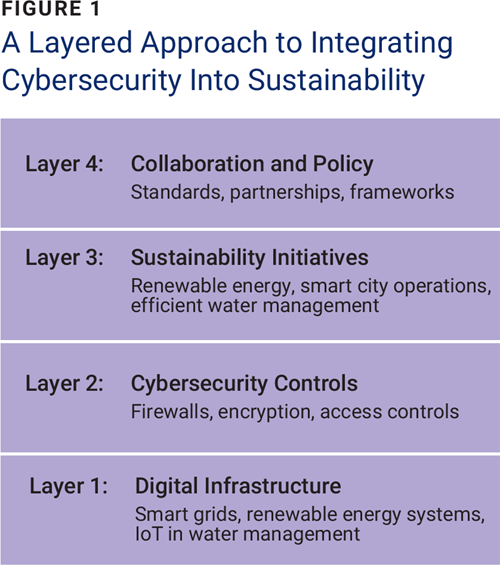
Organizations should prioritize investments in advanced security technologies, continuous monitoring, and regular audits. These measures are crucial for identifying vulnerabilities before they can be exploited and maintaining robust defenses against evolving threats. Figure 1 illustrates a layered approach to integrating cybersecurity into sustainability, from protecting digital infrastructure to fostering collaboration and policy development.
Developing rapid response strategies is equally important, enabling swift action to minimize damage in the event of a breach. This means having incident response plans that are regularly tested and updated to reflect the latest threats and vulnerabilities.
Moreover, organizations can bolster their defenses by equipping all stakeholders with the knowledge and skills to identify and respond to cyberthreats. This underscores the indispensability of education and training in safeguarding against potential attacks. IT professionals and those working directly on sustainability projects must understand the importance of cybersecurity and its impact on their work. Furthermore, cybersecurity education should be integrated into the training programs of all employees, ensuring that everyone understands cyberrisk and proper mitigation methods.
Another critical aspect of integrating cybersecurity into sustainability strategies is the adoption of a risk-based approach. This involves identifying the most critical assets and systems within an organization and prioritizing their protection based on the potential impact of a cyberattack. By focusing resources on the areas of greatest risk, organizations can maximize the effectiveness of their cybersecurity efforts and ensure that their sustainability initiatives are protected from the most serious threats.
Collaboration: The Cornerstone of a Secure Sustainable Future
The challenges of cybersecurity in sustainability demand collaborative solutions. Governments, enterprises, academics, and individuals must join forces to establish comprehensive security standards, share intelligence on emerging threats, and foster a united front against cyberadversaries. International cooperation is particularly important, as cyberthreats and sustainability initiatives often transcend national borders. By working together, countries can develop a unified approach to cybersecurity that supports global sustainability goals.
By focusing resources on the areas of greatest risk, organizations can maximize the effectiveness of their cybersecurity efforts and ensure that their sustainability initiatives are protected from the most serious threats.For example, international frameworks such as the United Nations 2016 Paris Agreement7 could be expanded to include provisions for cybersecurity, ensuring that all participating nations commit to protecting the digital infrastructure that underpins their sustainability efforts. Similarly, public-private partnerships can play a crucial role in developing and implementing innovative cybersecurity solutions tailored to the unique needs of sustainability projects. For enterprises to form such partnerships, they can begin by identifying key government agencies, academic institutions, and private sector organizations that share aligned goals in both sustainability and cybersecurity. These partnerships often involve collaborative research, resource sharing, and co-developing technologies that address specific vulnerabilities in sustainable infrastructure, such as renewable energy grids or smart cities.
The benefits of these partnerships are substantial. Enterprises gain access to government resources and funding, while the public sector benefits from the agility and innovation of private companies. Public-private partnerships can accelerate the development of cybersecurity standards that protect critical infrastructure, enhance information sharing between stakeholders, and encourage the deployment of cutting-edge security technologies at a faster pace than would be possible through government or private efforts alone.
One notable initiative is the partnership between Siemens Energy and the US Department of Energy, which is developing cybersecurity solutions for the renewable energy grid.8 This initiative focuses on securing the digital systems that manage wind and solar energy, helping prevent cyberattacks that could disrupt energy distribution. Another example is the partnership between the European Union and private institutions, such as the European Union Agency for Cybersecurity (ENISA), which are working to standardize cybersecurity measures across EU member states for sustainable technologies such as electric vehicle infrastructure and smart cities.9
Collaborative research initiatives can also drive the development of new technologies and best practices, ensuring that the cybersecurity measures deployed today are capable of addressing the challenges of tomorrow. For example, organizations such as the European Cybersecurity Organization (ECSO) foster collaboration between academia, industry, and government to develop adaptive cybersecurity solutions for critical infrastructure.10 Such initiatives anticipate emerging threats and build long-term resilience into sustainable technologies.
Moreover, cross-sector collaboration is essential for addressing the complex challenges posed by cybersecurity in sustainability. Industry leaders, policymakers, and cybersecurity experts must work together to create comprehensive strategies that address the unique vulnerabilities of sustainable technologies. This collaboration should also extend to international bodies, which can facilitate the exchange of information and the development of global standards.
In addition to formal collaborations, informal networks and communities of practice (CoPs) play a vital role in advancing the field of cybersecurity in sustainability. One example is the Global Forum on Cyber Expertise (GFCE), which connects professionals across sectors to share knowledge of cybersecurity challenges.11 These networks provide a platform for professionals to share experiences, discuss emerging trends, and develop new approaches to common challenges. By fostering a culture of collaboration and continuous learning, these communities contribute to the ongoing evolution of best practices and the development of more resilient systems.
Emerging Trends and Technologies
As organizations look to the future, several emerging trends and technologies are becoming increasingly central to sustainability initiatives. These technologies offer enormous potential to optimize resources, reduce waste, and enhance efficiency in areas such as energy management and supply chains. However, their increasing complexity also makes them prime targets for cyberattacks that could undermine sustainability goals. Organizations must integrate cybersecurity measures into these technologies to protect their sustainability initiatives.
AI/ML
AI and ML have proven to be transformative tools for optimizing energy use, particularly in smart grids, where they help balance energy supply and demand in real time. However, these AI-driven systems are susceptible to attacks that could disrupt their algorithms or feed them false data, leading to imbalanced energy distribution or resource waste. For example, attackers could alter the data used by AI models to predict energy usage, resulting in overconsumption or even blackouts and jeopardizing energy efficiency goals. To address this risk, organizations should invest in adversarial testing and continuous monitoring to ensure that AI systems remain secure and reliable throughout their use.12
IoT
IoT is another technology that has revolutionized sustainability efforts, from smart cities to industrial operations. IoT devices can help monitor energy consumption, water usage, and environmental conditions in real time, significantly reducing waste. However, IoT devices are also notorious for their vulnerabilities, as each connected device represents an entry point for cybercriminals. A cyberattack on a smart city’s IoT infrastructure could manipulate sensor data, disrupting resource distribution and causing environmental or operational harm. Given the scale of IoT networks, such attacks could have widespread consequences if not mitigated. Implementing strong authentication protocols, data encryption, and network segmentation is critical to protecting IoT ecosystems from being compromised.13
Blockchain
Blockchain technology has the potential to enhance transparency and accountability in sustainability initiatives, particularly in supply chain management. Blockchain can be used to verify the ethical sourcing of materials and ensure compliance with environmental standards. However, blockchain networks are not invulnerable to attacks. A 51% attack, for instance, could allow attackers to take control of most of the network’s mining power and manipulate transactions, potentially falsifying sustainability certifications or distorting the traceability of goods. Such an attack could erode trust in the system, making it essential for organizations to implement robust consensus mechanisms and conduct regular audits to ensure the integrity of their blockchain-based sustainability efforts.
Quantum Computing
Quantum computing, while still in its early stages, has the potential to dramatically improve the ability to model and optimize energy systems, offering new ways to address climate change. However, it also poses a significant threat to current encryption methods, which could be rendered obsolete by quantum computers capable of breaking traditional cryptography. This could expose critical systems, including those that manage renewable energy grids and environmental data, to unprecedented cyberattacks. Preparing for this eventuality requires the adoption of quantum-resistant encryption protocols that will protect these systems against upcoming advancements in quantum computing.14
These technologies are at the heart of many sustainability initiatives, but their vulnerabilities mean they must be secured to protect the integrity of those initiatives. Cyberattacks targeting AI/ML, IoT, blockchain, and quantum computing could undermine efforts to reduce resource consumption, improve efficiency, and ensure transparency in sustainability. By proactively addressing these risk factors and integrating cybersecurity strategies such as adversarial AI testing, IoT encryption, blockchain audits, and quantum-resistant cryptography, organizations can safeguard their sustainability goals and ensure the resilience of the digital systems that underpin them.
Conclusion
In today’s digital-first world, the convergence of cybersecurity and sustainability is no longer optional, it is essential. The very technologies driving sustainability, from smart grids to renewable energy systems, are becoming increasingly dependent on complex digital infrastructures. While this reliance brings significant benefits, it also exposes these systems to the growing threat of cyberattacks. These threats, if not managed, could undermine the progress that has been made toward a sustainable future.
To safeguard that future, cybersecurity must be viewed as the backbone of sustainability initiatives. Ensuring that the digital frameworks enabling sustainable practices are secure means protecting the systems that power renewable energy sources, manage water resources, and drive smart cities. The risk of cyberattacks can no longer be seen as separate from sustainability efforts—both must be addressed in tandem if we are to build a resilient and sustainable world.
As organizations and governments continue to invest in greener technologies, they must also prioritize cybersecurity at every step. This requires a proactive, integrated approach where the security of digital systems is planned from the outset, rather than being retrofitted after vulnerabilities are discovered. Through collaboration, innovation, and a shared commitment to protecting digital and environmental landscapes, we can forge a future where sustainability is not just a goal, but a secure reality.
Ultimately, cybersecurity is not only about protecting data or stopping cyberattacks; it is about ensuring that the critical infrastructure that supports our planet’s sustainability is safeguarded, resilient, and able to withstand the challenges ahead. By weaving cybersecurity into the fabric of sustainability, we can create a future that is both environmentally sound and digitally secure, ensuring the well-being of generations to come.
Endnotes
1 World Economic Forum, The Global Risks Report 2021, 2021
2 Zetter, K.; “Inside the Cunning, Unprecedented Hack of Ukraine's Power Grid,” Wired, 3 March 2016
3 Greenberg, A.; “A Hacker Tried to Poison a Florida City's Water Supply, Officials Say,” Wired, 8 February 2021
4 Reuters, “Tesla Cars, Bluetooth Locks, Vulnerable to Hackers, Researchers Say,” 17 May 2022
5 Raywood, D.; “Top Ten Ways Atlanta's Ransomware Attack Affected Cybersecurity,” Infosecurity Magazine, 26 July 2018
6 Rajak, P.; Ganguly, A.; et al.; "Internet of Things and Smart Sensors in Agriculture: Scopes and Challenges," Journal of Agriculture and Food Research, vol. 14, 2023
7 United Nations, The Paris Agreement, 2016
8 Iacullo, J.D.; “U.S. Energy Sector Draws Praise for Agility and Forward Thinking in Cybersecurity Realm,” Industrial Cyber, 20 March 2021
9 ENISA, , European Union, 21 January 2016
10 European Cyber Security Organisation, “” European Union
11 Global Forum on Cyber Expertise, “About GFCE,” 2022, https://thegfce.org/about-gfce/
12 Brundage, M.; Avin, S.; et al.; The Malicious Use of Artificial Intelligence: Forecasting, Prevention, and Mitigation, Arxiv, 20 February 2018
13 National Institute of Standards and Technology (NIST), NIST Framework for Improving Critical Infrastructure Cybersecurity, Version 1.1., USA, 2018
14 Chen, L.; Jordan, S.; et al.; Report on PostQuantum Cryptography, National Institute of Standards and Technology, USA, 2016
ABDULRAHMAN ALBLOOSHI, CISM
Is a cybersecurity professional with extensive experience protecting digital systems and data. His work focuses on ensuring the security and resilience of technological infrastructures, particularly in the context of sustainability initiatives. Alblooshi is passionate about advancing discussions of the critical role of cybersecurity in achieving sustainable development goals and creating a secure digital future.