
In today's technology-driven world, IT governance plays a pivotal role in ensuring organizational success. As organizations increasingly rely on IT resources to achieve their strategic objectives, the frameworks that guide IT governance become essential. To fully understand the complexities of IT governance, it is vital to examine organizational processes, inherent challenges, and pathways to successful implementation.
IT governance acts as a critical framework that aligns IT initiatives with organizational goals, ensuring efficient use of resources and effective risk management. Frameworks such as COSO,1 COBIT®,2 and ITIL, and the International Organization for Standardization (ISO)/International Electrotechnical Commission (IEC) standard ISO/IEC 385003 provide structured approaches to govern IT processes. Yet organizations continue to face numerous challenges including cybersecurity threats, data privacy concerns, and the rapid pace of technological change. Moreover, misalignment between IT and the organization’s stakeholders can hinder effective governance, complicating the relationship between technology and organizational strategy.
When alignment between the enterprise and IT is compromised, communication and priorities suffer, leading to inefficient resource allocation and a lack of transparency in achieving risk reduction.It is a necessity for organizations to navigate these challenges proactively by fostering collaboration among stakeholders and promoting a culture of continuous improvement. By emphasizing the need for strong leadership commitment and a clear strategic vision, a roadmap for implementing successful IT governance practices becomes clear. Ultimately, understanding and addressing the various forces at play in IT governance is vital for organizations aiming to leverage technology effectively and achieve sustained success.
The Predicament of IT Governance: Overcoming Challenges
Poor governance significantly influences organizational alignment and risk management. A lack of effective governance can lead to the inadequate identification of sensitive data, critical services, and security controls. Furthermore, when alignment between the enterprise and IT is compromised, communication and priorities suffer, leading to inefficient resource allocation and a lack of transparency in achieving risk reduction.4
Presently, economic uncertainty affects the IT industry in various ways, ranging from reduced spending on technology, delays or cancellations of projects, talent management challenges, and supply chain disruptions. As a result, IT enterprises must be agile and adaptable in order to survive and thrive in an unpredictable economic landscape. The imperative to consistently generate organizational value persists, and the evolving landscape of work methodologies and the strategic utilization of IT are continually reshaping the chief information officer (CIO) agenda. The demands placed on CIOs are expanding, with increasing pressure to embrace emerging technologies, enhance efficiency, navigate staffing challenges, and address the existing technology skill gap simultaneously.5
Key governance challenges include:
- In the context of cybersecurity threats, the ever-evolving landscape presents a formidable challenge for IT governance. Organizations are compelled to maintain constant vigilance by regularly updating security measures to protect sensitive information from potential breaches, ransomware attacks, and various other cyberthreats. A second significant challenge emerges in the realm of data privacy and compliance, where increasingly stringent regulations such as the EU General Data Protection Regulation (GDPR)6 and the US State of California Consumer Privacy Act (CCPA)7 demand responsible data handling and protection. Striking a balance between compliance with these regulations and effective data management poses a substantial challenge.
- The rapid pace of technological advancement adds another layer of complexity. The adoption of new tools, platforms, and methodologies becomes a test for IT governance professionals tasked with ensuring that organizations can embrace emerging technologies while upholding stability and security. The widespread adoption of cloud services introduces its own set of challenges in cloud governance. Organizations must establish clear policies for cloud usage, data storage, and access control to ensure both compliance and security.
- Vendor management can be challenging for organizations that rely heavily on third-party vendors for various IT services. Effectively managing these relationships and ensuring vendor adherence to established security and compliance standards become paramount tasks. Vendor management faces obstacles such as ensuring consistent quality, timely delivery, and cost control across multiple suppliers while maintaining strong communication and relationships. Additionally, managing risk related to vendor reliability, compliance, and potential disruptions in supply chains can complicate the process.
- Maintaining the delicate balance between innovation and risk management is another intricate challenge. IT governance is tasked with fostering innovation without compromising security or compliance standards. Cultural change stands as a significant hurdle, as the effective implementation of IT governance often requires a shift in organizational culture. Gaining stakeholder buy-in and fostering a culture of accountability and responsibility is essential, though it can be quite challenging.
- The IT skills gap introduces an additional layer of difficulty, as the scarcity of skilled professionals makes it challenging for organizations to acquire and retain the talent necessary for effective IT governance.
- Finally, operating in a global environment presents the challenge of navigating diverse regulatory frameworks and cultural diversity. Ensuring compliance with varying laws and regulations across different jurisdictions adds complexity to the all-embracing task of IT governance.
Addressing these challenging forces requires a proactive approach, ongoing education, collaboration between IT and stakeholders, and the implementation of robust governance frameworks tailored to the specific needs of each organization.
Diagnosing and Resolving Misalignment Issues in Organizations
The misalignment between IT and an organization’s stakeholders can occur for various reasons, often stemming from differences in priorities, communication issues, or misunderstandings.
The IT landscape evolves quickly, but governance approaches often struggle to keep pace. Over the past three decades, enhancing the alignment between IT and enterprise has remained a focal point for IT executives.8 This alignment aims to ensure that the right IT products and services are readily available to meet organizational needs, minimizing disruption for all stakeholders. In the pursuit of this alignment, IT has diligently endeavored to transform technologists into enterprise technologists, fostering service-oriented mindsets.
Common factors that may contribute to misalignment are:
- Communication gaps between IT and stakeholders can lead to misunderstandings and misinterpretations, stemming from differences in terminology, technical jargon, and organizational language. The misalignment is further exacerbated by divergent goals and objectives: IT teams prioritize technical efficiency and system stability, while organizational stakeholders focus on revenue generation, customer satisfaction, or market competitiveness. This disconnect arises when goals are not effectively communicated or understood.
- Limited involvement in decision-making processes by key stakeholders in both IT and organizational teams can result in decisions that do not align with the needs and expectations of both sides, separating them from the overall organizational strategy. Mismatched expectations concerning project timelines, deliverables, and functionalities may occur without clear communication, leading to differing views on project success.
- Inadequate understanding of organizational processes by IT teams and a lack of awareness of technical constraints by stakeholders can lead to solutions that do not meet organizational needs or are impractical from a technical standpoint. Resistance to change, especially from stakeholders, can hinder the successful implementation of new technologies or processes, arising from a lack of awareness, fear of disruption, or uncertainty about the benefits.
- Limited visibility into IT processes for stakeholders makes it challenging for them to comprehend the complexities and constraints faced by IT teams, contributing to the misalignment of expectations. Budgetary constraints can further contribute to misalignment, as limited budgets for IT projects may restrict the ability of IT teams to deliver solutions that meet the expectations of stakeholders.
- Inadequate IT governance structures can contribute to misalignment. Clear governance mechanisms are essential to align IT initiatives with overall organizational strategies, ensuring appropriate resource allocation and setting priorities in line with organizational goals.
- Finally, a lack of cross-functional collaboration due to siloed organizational structures can impede alignment between IT and stakeholders, as successful projects often require teamwork across different departments.
Cybersecurity professionals play a key role in promoting open communication between IT teams and stakeholders, ensuring alignment on vendor expectations, service level agreements (SLAs), and performance metrics to identify issues early and build stronger relationships. They also encourage a shared understanding of organizational goals and collaboration to manage vendor performance, address challenges, and drive mutual success. Regular meetings, joint planning sessions, and a culture of transparency are essential for overcoming obstacles and fostering a more effective partnership.
Comprehensive Overview of IT Governance: Framework, Attributes, and Positive Forces
IT governance encompasses a collection of guidelines and processes designed to ensure that an organization's IT activities align with its overarching organizational objectives. These activities encompass the organizational structure of IT teams, the acquisition of IT assets, and the configuration of IT infrastructures. The primary focus is on ensuring that all IT endeavors contribute to the attainment of the organization's goals.9
Figure 1 details the attributes of the proposed IT governance model. The model is broken down into a business process area with the stated attributes. Each of the framework attributes is broken down into key elements denoted by a sub-element, which is the representation of the executable initiative. The effectiveness of IT governance hinges on the presence of critical success factors (CSFs) representing the enablers of the business process attributes.
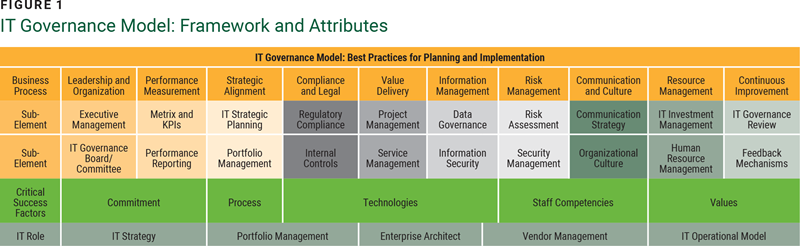
The business processes of IT governance are foundational components including:
- Leadership and organization play a crucial role by defining and communicating the IT strategy in alignment with the overarching organizational strategy. Concurrently, an IT governance board/committee is established to oversee and provide guidance for IT governance activities.
- Performance measurement involves defining and monitoring metrics and key performance indicators (KPIs) for IT and communicating IT performance to stakeholders through structured performance reporting.
- Strategic alignment is realized through the process of IT strategic planning, harmonizing the IT strategy with broader organizational objectives. Furthermore, portfolio management plays a pivotal role in prioritizing and supervising IT projects and initiatives to ensure strategic coherence.
- Compliance and legal ensure regulatory compliance, which is paramount for adherence to relevant laws and regulations. Internal controls are also implemented to achieve this.
- Value delivery encompasses project management, ensuring the successful execution of projects, and service management, which concentrates on the delivery and support of IT services.
- Information management and data governance guarantee the quality, availability, and integrity of data, and Information security protects information from unauthorized access and disclosure.
- Risk management and assessment identify and evaluate IT-related risk, accompanied by security management implementing measures to safeguard information assets.
- Communication and culture involve the development of a communication strategy to articulate IT goals and performance and foster an organizational culture that values and supports IT governance.
- Resource management oversees IT investment management, ensuring optimal resource allocation for IT initiatives, and human resource management, responsible for managing IT personnel and their skill sets.
- Continuous improvement is achieved through periodic IT governance reviews, assessing the effectiveness of the governance framework, and encouraging feedback mechanisms from stakeholders to drive ongoing enhancements.
The proposed model provides a clear, logical structure for breaking down complex decisions into manageable parts. It organizes decision elements hierarchically, which helps in understanding the relationships and dependencies between criteria and alternatives. It supports collaborative decision making by aggregating the judgments of multiple decision makers. This makes it suitable for team-based or stakeholder-driven projects.
Navigating Positive, Negative, and Misalignment Factors
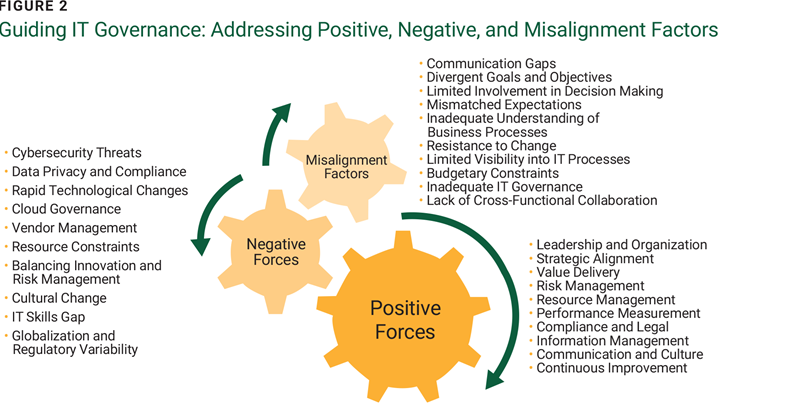
The driving forces of IT governance include positive, negative, and misalignment factors, each with specific attributes. A crucial element of success involves strong management commitment and recognition aiming to maximize positive aspects, minimize negatives, and address misalignment effectively.
Positive forces include leadership, strategic alignment, value delivery, risk and resource management, performance measurement, compliance and legal, information management, communication and culture, and continuous improvement. For example, an enterprise’s IT strategy is closely aligned with its organizational goals, resulting in IT projects that directly contribute to revenue growth and customer satisfaction.
Negative forces encompass cybersecurity threats, data privacy and compliance, rapid technological changes, cloud governance, vendor management, resource constraints, balancing innovation and risk management, cultural change, IT skills gaps, and globalization with regulatory variability. For example, an enterprise that migrates to the cloud without proper governance policies can lead to data breaches due to misconfigured security settings and uncontrolled access.
Misalignment factors are communication gaps, divergent goals, limited involvement in decision making, mismatched expectations, inadequate understanding of business processes, resistance to change, limited visibility into IT processes, budgetary constraints, inadequate IT governance, and lack of cross-functional collaboration. For example, many organizations manage data privacy and security in isolated silos. Privacy teams concentrate on data mapping, security teams oversee risk monitoring, and data governance teams maintain catalogs. This fragmented approach adds to overall complexity.10
Success in IT governance implementation hinges on strong leadership commitment, clear communication, and active collaboration among stakeholders.Figure 2 symbolizes synchronization among the factors of misalignment, negative forces, and positive forces. Just as gears must be aligned and work in harmony to drive a machine efficiently, the factors of misalignment (which can disrupt synchronization), negative forces (which may resist progress), and positive forces (which drive success) need to be carefully balanced and synchronized for optimal outcomes. Figure 2 highlights the interconnectedness and the need for each factor to function in coordination, reinforcing the importance of alignment and collaboration in achieving a unified goal.
Achieving Successful IT Governance
The successful implementation of IT governance necessitates collaboration between IT managers and organizational stakeholders. This process provides an opportunity to elevate IT managers to the C-suite, enabling them to contribute to well-informed IT decision making. To ensure success, it is crucial to comprehend the specific needs of the organization and identify current deficiencies to address them effectively.11
The implementation of IT governance in an organization aims to achieve several key outcomes. First, it ensures that information and technology contribute to generating tangible value. Additionally, IT governance involves overseeing the performance of IT managers, assessing risk associated with the IT department, and establishing comprehensive disaster recovery plans. The model depicted also emphasizes the importance of providing transparency and accountability in IT operations. Furthermore, IT governance plays a crucial role in defining standards for IT project management. It extends its purview to the financial aspects of IT, overseeing elements such as capital budgeting and capital spending to ensure effective financial management.
The essential elements for the success of IT governance include a clear sense of purpose, unwavering commitment from senior management, adept management of organizational changes, a focused approach, effective execution and enforcement, measurement of attainable targets and expectations, and a preference for evolution rather than revolution.
For the IT governance implementation initiative to thrive, a sponsor must assume ownership, engage all crucial leadership executives, and establish a solid business case (e.g., by emphasizing the importance of regulatory requirements). Initially, the business case should adopt a high-level strategic perspective, commencing from the top down. This involves gaining a clear understanding of the desired outcomes and subsequently evolving into a detailed delineation of critical tasks and milestones.12
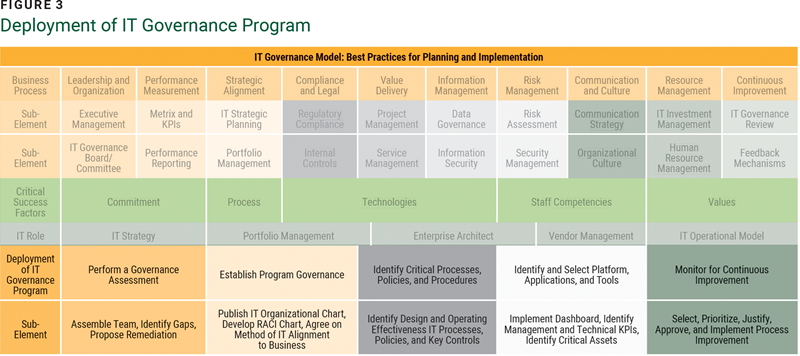
As depicted in figure 3, the deployment of an IT governance program involves planning the implementation of IT governance, encompassing several attributes and their related actions:
- Perform a governance assessment—Form a team, identify gaps, and propose remediation strategies.
- Establish program governance—Publish the IT organization chart, develop Responsible, Accountable, Consult, and Inform (RACI) roles, and agree on methods to align IT with enterprise objectives.
- Identify and document critical IT policies and procedures—Assess the design and operating effectiveness of key controls within these policies.
- Identify and select IT platforms, applications, and tools—Implement dashboards, identify, capture, and report key organizational and technology KPIs, and identify critical assets.
- Monitor for continuous improvement—Reach consensus on process improvement by selecting, prioritizing, justifying, approving, and implementing such initiatives.
Conclusion
Effective IT governance is essential for aligning technology initiatives with organizational goals, optimizing resource use, and mitigating risk. The proposed model provides valuable structures for guiding IT governance efforts, yet organizations must remain vigilant in addressing the myriad challenges they face, including cybersecurity threats, data privacy regulations, and the rapid evolution of technology.
Success in IT governance implementation hinges on strong leadership commitment, clear communication, and active collaboration among stakeholders. By fostering a culture that values transparency, accountability, and continuous improvement, organizations can navigate the complexities of IT governance more effectively.
Ultimately, addressing issues of misalignment and leveraging the positive forces of governance are crucial for realizing the full potential of IT investments. As organizations continue to adapt to changing environments, a robust IT governance model will be instrumental in driving sustainable success and delivering tangible value.
Endnotes
1 Committee of Sponsoring Organizations of the Treadway Commission, Internal Control-Integrated Framework, 2013
2 ISACA®, COBIT®
3 International Organization for Standardization (ISO), International Electrotechnical Commission (IEC), ISO/IEC 38500:2024 Information technology—Governance of IT for the organization, 2024
4 Curtis, B.; “The Value of IT Governance,” ISACA, 29 June 2020
5 Pratt, M.K.; “12 Biggest Issues IT Faces Today,” CIO, 12 June 2024
6 Regulation (EU) 2016/679 of the European Parliament and of the Council of 27 April 2016 on the protection of natural persons with regard to the processing of personal data and on the free movement of such data, and repealing Directive 95/46/EC (General Data Protection Regulation [or GDPR]) (OJ L 119, 4.5.2016, p. 1)
7 Cal. Civ. Code § 1798.100 et seq.
8 Cramm, S.; “Can the IT-Business Marriage Be Saved?,” Harvard Business Review, 26 September 2008
9 Landau, P.; “IT Governance: Definitions, Frameworks, Planning,” ProjectManager, 27 October 2023
10 Muckenfuß, F.; “Reinforcing IT Governance in the Face of Constant Threats,” ISACA, 21 May 2024
11 Electric, “How to Implement IT Governance,” 8 February 2022
12 Lainhart, J.; “A Roadmap for Implementing and Improving IT Governance,” IBM Center for the Business of Government, 7 March 2016
ROBERT PUTRUS | CISM, PMP, PE
Is a professional with senior management experience in IT, cybersecurity, regulatory and internal controls compliance, managed services, global transformation programs, portfolio and program management, and IT outsourcing. He has published many articles and white papers in professional journals, some of which have been translated into multiple languages. Putrus is quoted in publications, articles, and books, including those used in Master of Business Administration programs in the United States. He can be reached at robertputrus@therobertsglobal.com or https://www.linkedin.com/in/robert-putrus-cism-pmp-pe-8793256/.