
While the term “green technology” brings to mind operational technologies such as electric vehicles and wind farms, there are also many green information technologies to consider. Examples include energy-efficient data centers, Internet of Things (IoT) devices in smart buildings, green software (which requires less computing power), green hardware (which is developed using fewer toxic materials), remote work technologies, and even electronic waste management. Green IT can be a disruptive catalyst for further innovation, and it can have a transformative influence on traditional industries and practices, such as when operational efficiencies create competitive responses in the market.
Green IT should be subject to the same rigors of IT governance as regular IT to help ensure that it is a productive addition to the organization’s IT ecosystem and produces the anticipated value. IT governance:
- Ensures the alignment of IT with organizational objectives
- Estimates the benefits of the proposed IT by means of a business case, and after deployment, measures its actual performance against those estimates to determine whether the investment is as meaningful to the organization as proposed
- Ensures that the risk associated with IT is managed
- Ensures that organizational capabilities are developed to sustainably support the new tool in the organization’s IT ecosystem
Strategic alignment, risk management, benefits tracking, and capability development make up four of the Certified in the Governance of Enterprise IT® (CGEIT®) domains.1 To ensure overall IT productivity, the aforementioned governance attributes should be underpinned by the primary CGEIT domain, a robust IT governance framework based on, for example, International Organization for Standardization (ISO)/International Electrotechnical Commission (IEC) standard ISO/IEC 385002, or even simply one’s CGEIT manual. In the case of green IT, credible, data-driven metrics based on environmental economics principles to support green IT’s environmental claims need to be prioritized.
There is ultimately an urgent need to establish the appropriate governance of green IT to ensure that organizational resources are appropriately allocated to this category of IT. This journey starts with understanding environmental economics and the concept of externalities, as well as green IT strategic alignment, business cases, benefits realization, risk, and capability building.
Note that this is not an article about the ethics of green technology for any particular stakeholder. It simply aims to highlight the role of IT governance in ensuring that green IT is appropriately deployed in an organization, and that it realizes the claims of improved environmental outcomes.
The Organizational Context for Green IT
An organization’s impact on the environment in which it operates is an elementary component of sustainability paradigms such as environment, social, and governance (ESG) concepts. For some organizations, this may be as simple as wishing to consciously minimize their impact on the environment as a whole, perhaps due to social or regulatorypressures.
Claims that a new technology is more environmentally friendly than an old technology, based on just a small part of the entire picture, are misleading at a minimum.Consider the concepts illustrated in figure 1. Both social and regulatory pressures occur in an environment external to the organization (1). These then drive a business requirement that sees green IT as a solution to these pressures (2). Building a business case for green IT would require an understanding of environmental economics (3), not just of the organizational financials of the proposed technology. This is complemented by ensuring the strategic alignment and risk management of the new IT (4). Finally, operationalizing all of this depends on building the internal capability (5) to manage and use the new technology in a way that realizes the business case. The bidirectional arrows in the internal environment component of figure 1 indicate feedback loops between items 2 to 5 as part of an organization’s continuous improvement initiatives.
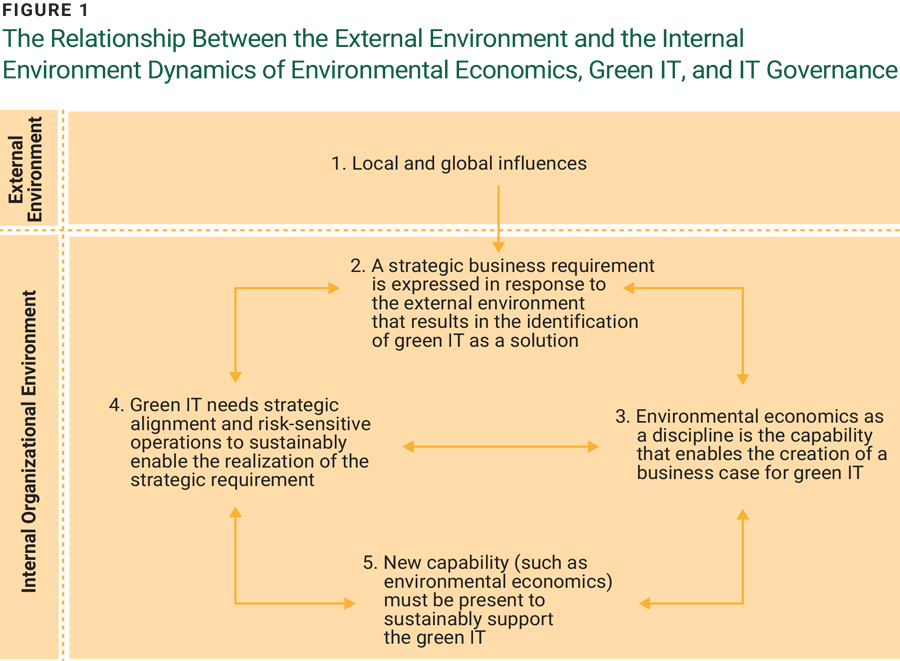
Holistically, the main difference between the business case assessment of regular IT and the assessment of green IT (point 3 in figure 1) is the need to understand the upstream, organizational, and downstream environmental implications of the technology (as shown in figure 2), not merely the impact of the technology on the organization. A full green IT assessment should consider the environmental impact of the acquisition of the raw materials to create the technology (upstream), the environmental impact of the technology in operation (e.g., the environmental impact of its electricity consumption while in use), as well as the impact of the electronic waste on the environment (downstream) when it is decommissioned.
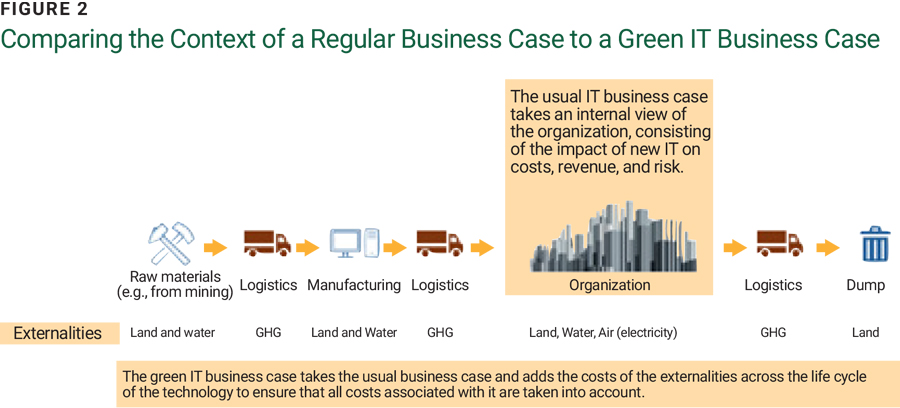
Some may only analyze the environmental impact of the proposed new green IT on their organization, but this would tell merely a fraction of the story. Without a full assessment as proposed in figure 2, an organization may replace an existing technology with a new technology that appears to have a lower environmental footprint. However, this could have a much larger negative impact on the environment as a whole compared to the existing technology. Claims that a new technology is more environmentally friendly than an old technology, based on just a small part of the entire picture, are misleading at a minimum.
Note that figure 2 is a simplified representation; there are many more externalities at each point of the value chain for an IT device than shown here.
Given the organizational reputation risk of greenwashing—the reporting of unsubstantiated environmental benefits of an organization’s activity—there is a governance imperative to ensure that green IT is not subject to it. The need is thus to develop the organizational capability to understand environmental economics in the context of IT, and to apply this knowledge to ensure green IT strategic alignment both to business cases that show the positive environmental impact of green IT and to IT risk management mechanisms that are sensitive to the environmental risk of IT.
Environmental Economics and IT Externalities
In economics, an externality refers to the unaccounted cost (or benefit) impacting one party as a result of the activities of another party.3 The externalities of interest are the negativeimpacts of activities on the environment, such as toxic waste.4 Externalities are indicators of market failure, i.e., when the market does not allocate resources to balance all costs, including toxic waste cleanup,5 against the proposed benefits. Toxic waste is a cost to the environment that is generally unaccounted for in a typical business case (e.g., the environmental cost of the excessive energy consumption of cryptocurrencytechnology).6
Toxic waste not only negatively impacts the quality of the physical environment, such as the land, water, and air that support various biological ecosystems, but it can also take forms such as noise pollution7 (e.g., traffic noise) and pollution by excessive or inappropriate lighting, which can have a disruptive effect on natural cycles.8 Hope is not part of the lexicon of good governance.Unlike typical enterprise IT economics that focus on direct dollar benefits and costs to assess the impact on profit, green IT economics focuses on all of these plus the direct and indirect effects of the proposed green IT on the environment, especially in terms of contemporary challenges such as toxic waste. Why is the issue of toxic waste so important for IT? A sobering fact is that digital is not nearly as clean as one might have thought; digital waste constitutes approximately 70% of all toxic waste.9
In Canada (as in many other countries), the externalities in focus are greenhouse gas emissions (GHGs), made evident by a carbon tax program that aims to reduce GHGs.10 However, the Canadian government does not specify time-boxed targets for the reduction of GHGs—as would be required by good governance—making the conditions under which such a program would be deemed to be an objective success unclear. Instead, there seems to be an implied hope that money reallocated by means of the carbon tax will result in low-GHG technologies being developed that will ultimately replace those that create high levels of GHGs. Hope is not part of the lexicon of good governance.
How big is the GHG problem for IT? The digital sector currently contributes 2.9%-3.5% of GHGs (figure 3).11 However, another source suggests that the digital sector contributes as low as 1.8% and as high as 3.9% of GHGs.12 This illustrates some of the challenges with standards of GHG measurement. Interestingly, personal computing as a subset of the digital sector contributes as much as 1% of GHGs, although carbon footprint information seems to be inconsistent at this level of detail.13 This highlights the measurability issue for digital in general or even of green IT, especially at lower levels of detail than would be encountered at an organizational level.
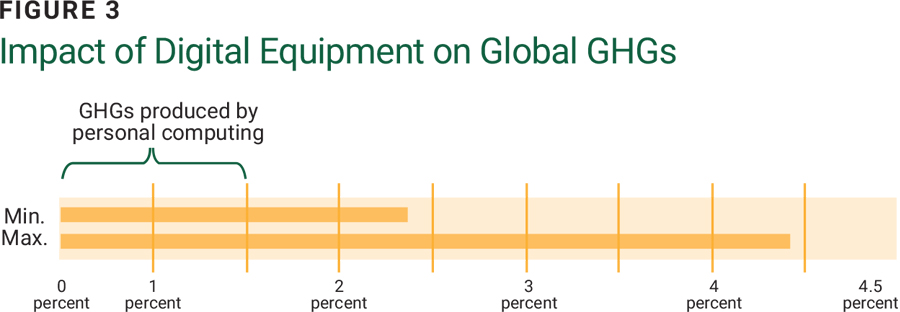
Note that figure 3 only displays GHGs, not all externalities (e.g., land and water).
GHGs are only part of the problem for IT though. For example, an externality of growing international concern is the disposal of the aforementioned digital waste. Ghana has become a major destination for eWaste from developed countries. In this region alone, 10,000 informal workers search for valuable recyclables within the waste.14 These workers suffer burns and infected wounds, as well as “respiratory problems, chronic nausea, and debilitating headaches” as a result of toxic air pollution and working in a hazardous environment.15
It is not likely that any IT business case considers such end-of-life costs of the technology to the environment. Any claims of an IT being green without demonstrating a positive environmental impact both upstream and downstream from the organization may struggle to convince some people that their claims are not greenwashing. While end-of-life IT externality costs are difficult to determine for the green IT business case, the real-life environmental impact on people in eWaste hubs around the world, like Ghana, is all too real, including in locations such as Cameroon, China, Kenya, and the Philippines.16 Claims that an IT truly is green need to be supported with evidence.
A common quality touted to support the claim that a technology is green is its ability to be recycled. However, a lesser-known statistic is that only approximately 20% of digital waste is recycled; the rest becomes material for toxic landfills.17 As such, “The e-waste problem could expand into a global health crisis, largely affecting urban areas”18 if not addressed.
However, the complexity increases further: There are blurred boundaries in green IT economics. For example, more efficient green IT may directly reduce organizational operating costs, but it may also only indirectly reduce the original energy supplier’s pollution as a result of the lower need for energy, if at all.
Understanding and handling issues such as these are generally not within the ambit of typical IT staff. This means that understanding environmental economics sufficiently enough to create a credible business case for green IT—as would be required by good IT governance—will require an investment in new skills to be introduced into the organization’s IT team.
Three Topical Issues in Green IT Governance
From IT greenwashing to the potential prioritization of relatively higher risk green IT over a minimum-risk IT operating environment, there are significant IT governance implications for green IT.
Strategic Alignment and Risk
Through a governance lens, the most important question an organization needs to ask itself in pursuit of a reduced IT carbon footprint—the GHG focus—is what green goals it wants to achieve. This means an investigation of the organizational externalities introduced by its IT portfolio that it aims to reduce. For these aims to be achievable, the externalities need to be at least somewhat under the organization’s control.
Another important question that would help understand the motivations of the stakeholder is: Who is driving the conversation around reducing IT externalities? Is it the customer, or societal pressures? Is it a funder? Is it a shareholder?
The more objective the measurement of the environmental benefits of green IT, the more credible the claims.Is it a regulator? Is it the chief executive officer (CEO) or president? Determining who is driving the requirement will help determine the in-scope externalities. For example, customers concerned about the environmental impact of the polystyrene used to transport new IT equipment may demand changes to the packaging of the equipment.
From an IT governance perspective, the key pillars at hand are strategic alignment and risk. It will be necessary to ensure that the green objectives are expressed at the organizational level in such a way that the IT team can find a way to achieve those objectives. Depending on the driving stakeholder group, it may be determined that alignment is required outside of the organization, which is a departure from the regular IT governance process. Further risk to consider is the implications for the sustainability of the IT ecosystem operations while the organization tries to achieve the desired green IT goals.
Business Case and Benefits Tracking
The green IT business case needs to show how the benefits of green IT extend beyond traditional financial metrics (e.g., cost savings, incremental revenue) to produce positive environmental impacts. For example:
- Google’s energy-efficient data centers—“We’ve worked hard to minimize the environmental impact of these services so that when you use our products, you’re also being good to the environment.”19
- Microsoft’s goal of carbon neutrality—“By 2030 Microsoft will be carbon negative.”20
Similar to enterprise economics, in environmental economics, the challenge is to define objectively credible measures. In the mentioned examples, those measures are “minimize the environmental impact” and “[become] carbon negative.” Compared to Microsoft, Google’s claim reads as vague.
Measurability is key to tracking IT benefits. If it is not measurable, then no matter how good the metric is in theory, no evidence of the benefits of the technology can be shown. Vague or missing metrics are an IT governance failure because the claimed benefits that resulted in the allocation of scarce organizational financial resources to the technology will not be able to be demonstrated, potentially leading to internal investigations into why the poor decision was made when the business case is audited.
The impact of unsubstantiated environmental benefits of green technology (or “greenwashing”) on organizations can be significant. A high-profile greenwashing example is when automotive manufacturer Volkswagen highlighted the “low.emissions and eco-friendly features” of its vehicles, in contrast to the reality of them “emitting up to 40 times the allowed limit for nitrogen oxide pollutants.”21 The CEO was suspended during investigations and was required to pay Volkswagen nearly US$14 million after an investigation found a failure of the now ex-CEO to respond properly to the illegal diesel technology.22 From a green IT perspective, while Microsoft’s claim is seemingly measurable, Microsoft has also been accused of greenwashing.23 According to Microsoft’s chief sustainability officer, 96% of Microsoft’s emissions come from sources they do not directly control and are therefore difficult to reduce.24
In Canada, amendments to the Competition Act require enterprises to be able to prove any environmental claims made that promote a product or business interest.25 This is incidentally aligned with the IT governance requirement for benefits measurability. The key takeaway for the environmental economics of green IT is to ensure that claims are both objectively and credibly measurable, and that thebenefits arein the direct control of the organization making the claims. Fulfilling both these requirements will ensure that the requirements of thebenefits monitoring aspect ofITgovernance are met.
For credibility, it is important that environmental claims are measurable and supported by data. Furthermore, in the interest of good governance—specifically the elimination of conflicts of interest—the more objective the measurement of the environmental benefits of green IT, the more credible the claims. To this end, it is unclear whether the claims made by Google or Microsoft were objectively assessed.
Ultimately, the easier part of the green IT business case is assessing GHG reductions introduced by the green IT. This is because the global focus on GHGs—the impact of externalities on air quality—makes GHGs easier to analyze compared to land and water externalities given increasingly standardized approaches to calculating GHGs.26 For non-GHG externalities (the impact of externalities on land and water) this may require the creation of new data and new instruments for measurement by the organization to develop a full picture of the environmental impact of the new technology.
Resourcing and CapabilitiesA prime purpose of the chief information officer (CIO) is to keep the organization’s IT up and running. Competing priorities emerge when this purpose is compromised, such as while pursuing a reduction of externalities which diverts attention away from regular IT issues such as compliance, business continuity, disaster recovery, vendor management, security, identity and access management, data loss prevention, and more.
Assuming the CIO manages to keep the shop running while beginning to address those externalities, another challenge is that neither the CIO nor the IT governance professional is likely to be an expert in mining (for the raw materials of the digital world), logistics, energy, toxic materials, or sustainability. This may make it difficult for IT to produce credible green IT business cases and measure the performance of the green IT against that business case.
There is also the issue of controllability. While a green IT goal might be to source from enterprises with lesser environmental impacts, the control of that impact is not in the hands of IT. It is probably not even in the control of the manufacturer. In this case, the IT department is at least two degrees of control away from the source of the materials used to manufacture the product.
From an IT governance perspective, the key issues are resourcing (capacity development) and capability development. In other words, it is not only about increasing the resource volume to meet the demands (and experimentation) of green IT, but about ensuring that those resources have the appropriate combination of skills and experiences required to effectively contribute to the green IT space. If a business case capability already exists in the IT department, then an augmentation of the skills, knowledge, and experiences of the capability can be considered a means to address the challenges of green IT.
Conclusion
Green IT governance represents a shift in how organizations align their IT with internal and external environmental objectives. There are challenges the IT governance community will face, from aligning strategic goals with measurable internal and/or external environmental outcomes to navigating the complexities of externalities, stakeholder priorities, and the new organizational capabilities across the full digital life cycle.
Furthermore, to be competent in a world of green IT, organizations must build new skills and capabilities within IT teams to navigate the complexities of environmental impacts across the life cycle of information technology—from upstream sourcing to downstream waste management.
Developing a green IT business case that extends beyond consideration for GHGs is challenging. This difficulty arises because of carbon footprint standardization, while land and water externalities lack such standardization currently. This does not mean that it is not important, as the global eWaste problem demonstrates. Creating IT business cases as part of IT governance with consideration for externalities helps to create an awareness of the serious environmental consequences of digital life on the environment, from mining and manufacturing to logistics, to eWaste disposal. Indeed, in this way, IT governance could also become a vehicle for educating users about the total impact of the technology they love (and the technology they love to hate).
The effectiveness of green IT governance lies in its ability to balance environmental imperatives with operational priorities. When done well, organizations can position themselves as leaders in sustainable IT while avoiding pitfalls such as greenwashing or unsubstantiated claims. Green IT governance is not merely about adopting eco-friendly technologies. It requires ensuring that these initiatives deliver measurable, credible, and meaningful organizational benefits first, as well as environmental benefits that help protect the natural environment.
Endnotes
1 ISACA®, “CGEIT®”
2 International Organization for Standardization (ISO), International Electrotechnical Commission (IEC), ISO/IEC 38500:2024 Information technology—Governance of IT for the organization, 2024
3 Kenton, W.; “Externality: What It Means in Economics, With Positive and Negative Examples,” Investopedia, 18 June 2024
4 Helbling, T.; “Externalities: Prices Do Not Capture All Cost,” International Monetary Fund
5 Khan Academy, “The Economics of Pollution”
6 Huestis, S.; “Cryptocurrency’s Energy Consumption Problem,” RMI, 30 January 2023
7 National Geographic, “Noise Pollution”
8 National Geographic, “Light Pollution”
9 The World Counts, “Electronic Waste Facts”
10 Government of Canada, “How Carbon Pricing Works”
11 Brun, A.; Omnes, N.L.; et al.; “Impact of the Use of a Digital Teleworking Solution on Greenhouse Gas Emissions: Case Study of the Orange Atalante Site in Rennes,” Hello Future, 20 February 2024
12 Freitag, C.; Berners-Lee, M.; et al.; “,” Patterns, vol. 2, iss. 9, 2021
13 Sutton-Parker, J.; “Determining the Impact of Information Technology Greenhouse Gas Abatement at the Royal Borough of Kingston and Sutton Council,” Procedia Computer Science, vol. 203, 2022, p. 300-309
14 Yeung, P.; “The Toxic Effects of Electronic Waste in Accra, Ghana,” Bloomberg, 29 May 2019
15 Yeung; “The Toxic Effects”
16 Quantum, “A Closer Look at Electronic Waste Dumps Around the World,” 25 July 2024
17 Yeung; “The Toxic Effects”
18 Yeung; “The Toxic Effects”
19 Google, “Efficiency” Google Data Centers,
20 Smith, B.; “Microsoft Will Be Carbon Negative by 2030” Official Microsoft Blog, 16 January 2020
21 Robinson, D.; “10 Companies Called Out for Greenwashing” Earth.org, 17 July 2022,
22 Riley, C.; “Volkswagen’s Ex-CEO Pays Company $14 Million Over His Role in the Diesel Scandal,” CNN, 9 June 2021
23 Ashcroft, S.; “Microsoft Progress on Emissions 'Too Slow', Says its CSO,” Sustainability Magazine, 11 May 2023
24 Ashcroft, “Microsoft Progress on Emissions”
25 Shingler, B.; “Unhappy With New Greenwashing Rules, Alberta and Fossil Fuel Companies Push Back,” CBC, 11 July 2024
26 Greenhouse Gas Protocol, “Calculation Tools and Guidance”; Diginex, “The Best Methods and Standards for Carbon Footprint Calculation,” 15 June 2023; BDC, “Calculate Your Greenhouse Gas (GHG) Emissions”
GUY PEARCE | CGEIT, CDPSE
With an academic background in business, computer science, economics, and in the natural and built environment, Pearce has served in senior strategic leadership and governance roles in the private and public sectors. He has led digital transformations involving IT and data for most of his career, excelling in building sustainable enterprise capabilities that enable value creation. An industry thought leader with 100+ published articles, he was awarded the 2019 ISACA® Michael Cangemi Best Author award for contributions to IT governance.