
Digital twins—virtual replicas of physical assets, processes, or systems—are rapidly gaining traction across sectors from manufacturing to healthcare. Their emergence is transforming the way humans interact with the physical world while navigating their subversive potential. The COVID-19 pandemic accelerated this trend, and the global digital twin market is expected to grow from US$10.1 billion in 2023 to US$110.1 billion by 2028.1 However, as organizations struggle to harness the power of digital twins, they face complicated governance challenges that can undermine the technology's potential. There is value to be gained by exploring these complex governance challenges and possible strategies for addressing them, empowering organizations to better leverage digital twin technology while mitigating associated risk.
Evolution of Digital Twins
Digital twin technology is an innovation that enables deep understanding, analysis, and optimization of entities by creating precise digital replicas of physical entities in the virtual world. Imagine that a smart city's transportation system has a digital twin. The virtual model not only contains the real-time data of all streets, traffic lights, and vehicles in the city, but also can simulate the effects of various traffic policies. Traffic managers can use this virtual environment to evaluate scenarios such as adjusting signal timing or changing lane configurations and then observe the possible outcomes. In this way, they can find optimal solutions without affecting the actual traffic. The evolution of digital twins has been marked by significant milestones, as illustrated in figure 1. This timeline highlights the key developments that have shaped the technology from its conceptual inception to its widespread adoption across industries.
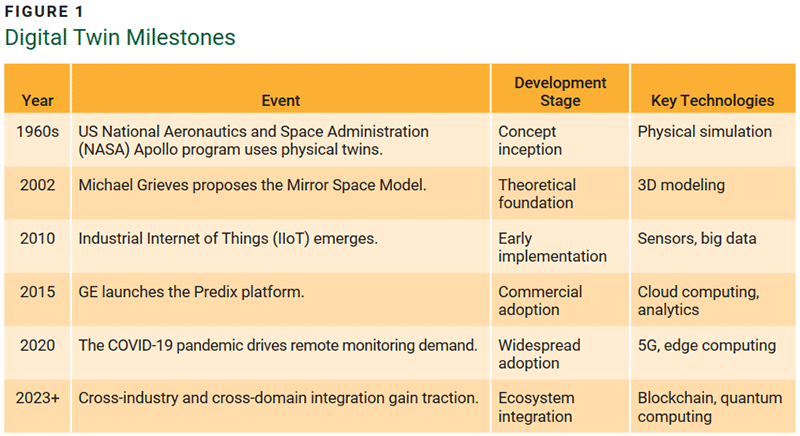
The concept of digital twins dates back to NASA's Apollo program in the 1960s. Engineers built an identical copy of the Apollo spacecraft to simulate and solve potential problems on Earth while astronauts carried out their missions in space. This practice laid the foundation for future digital twin technology. In 2003, Michael Grieves, a professor at the University of Michigan (USA), proposed the concept of the mirror space model, which further advanced theoretical development in the field.2 He provided an important conceptual framework for the development of digital twins. In 2011, the term "digital twin" was officially adopted by the U.S. Air Force Research Laboratory. It was defined as "an integrated multiphysics, multiscale, and probabilistic simulation of a constructed vehicle or system" that uses the best available physical models, sensor updates, fleet history, etc., to reflect the life of its corresponding twin.3 This definition clarifies the core features of digital twins and promotes the application of this technology in a broader range of areas.
In the context of digital twins, inaccurate data can lead to incorrect decisions.Digital twins are quickly gaining significance in three key sectors:
- Smart cities—Digital twins utilize IoT sensors to collect data on urban infrastructure, optimizing energy consumption and public services. They can also provide simulation platforms for planning future city development, including traffic flow management and emergency response.
- Manufacturing—Digital twins enable real-time monitoring and predictive maintenance, reducing downtime and optimizing supply chain management. Additionally, they support more accurate product design and testing, enhancing production efficiency and quality.
- Healthcare—Digital twins can offer personalized and precise medical services ranging from simulating human organs to evaluating drug effects and planning surgical procedures. The technology also combines AI algorithms with real-time and historical data to make more informed decisions, especially in emergencies where a quick response can save lives.
These diverse applications highlight the transformative potential of digital twin technology across various sectors. However, as organizations strive to harness this potential, they encounter a range of governance challenges that can significantly impact the technology's effectiveness and ethical use.
Governance Challenges in the Digital Twin Era
Digital twins demonstrate their adaptability across domains, from predictive maintenance of factory machines to healthcare monitoring. They show their unique value in specific areas, illustrating the rapid growth of digital twin applications driven by the synergistic advancement of AI, IoT, and the Fourth Industrial Revolution (Industry 4.0). Although they are becoming increasingly common across industries, they present a variety of governance challenges that organizations must address. These challenges arise from the complexity of digital twins, which integrate massive amounts of data from multiple sources and operate in real time.
As a decision support tool, digital twins rely heavily on accurate and timely data.Data Management and Quality
As a decision support tool, digital twins rely heavily on accurate and timely data. However, ensuring data quality and maintaining consistency across diverse sources is a challenging task. In the context of digital twins, inaccurate data can lead to incorrect decisions, which can result in significant financial losses or security risk. For example, in a smart manufacturing environment, a digital twin of a production line might integrate data from various sensors, historical production records, and supply chain information. If any of these data sources are inaccurate or inconsistent, it could lead to suboptimal production schedules, increased downtime, or even equipment failures. There is an urgent need for organizations to implement robust data governance frameworks to ensure the integrity, consistency, and reliability of the data powering their digital twins.
Security and Privacy Concerns
Because digital twins often involve sensitive operational data and intellectual property rights, they naturally become attractive targets for cyberattacks. Connecting digital twins expands the potential attack surface and can reveal vulnerabilities in the connected system. The Industrial Internet Consortium found that up to 79% of organizations surveyed considered cybersecurity a key concern when implementing digital twins.4 Particularly in areas where personal data is processed—such as healthcare applications—compliance with strict data protection regulations (e.g., the EU General Data Protection Regulation [GDPR] or the US Health Insurance Portability and Accountability Act [HIPAA]) is crucial.
To strike a balance between the need for comprehensive data and data protection, it is important to give careful consideration to the implementation of robust security measures. These may include:
- End-to-end encryption for all data transmissions
- Multifactor authentication (MFA) for accessing digital twin systems
- Regular security audits and penetration testing
- Implementation of blockchain technology for enhanced data integrity and traceability
The complexity of these security measures underscores the need for a holistic approach to digital twin governance, one that integrates cybersecurity considerations into every stage of development and implementation. As digital twin technology continues to evolve, so too must the strategies for protecting these valuable digital assets and the sensitive data they contain.
Ethical Considerations
The potential for bias in the algorithms and AI models that power digital twins cannot be ignored. Models that are trained on biased datasets or contain biased assumptions could perpetuate or even reinforce existing inequalities. For example, if urban digital twins are created based on historically biased data, they may inadvertently discriminate against some communities in urban planning. Furthermore, the digital divide—that is, the gap between those who have access to digital twin technology and those who do not—is an increasingly serious problem. As digital twins become more integrated into decision-making processes, this divide is exacerbating social and economic inequalities.
Crucially, organizations should take the initiative to respond to ethical challenges and conduct regular bias audits. Fostering diverse development teams and engaging with a wide range of stakeholders, including potentially affected communities, can help identify and mitigate potential biases early in the development process. In addition, investing in digital literacy programs and striving for transparency in digital twin decision-making processes can contribute to more equitable access and understanding of this technology. By taking these proactive steps, organizations can work towards ensuring that digital twins are developed and used responsibly, balancing technological advancement with ethical considerations.
Regulatory Landscape
Although digital twin technology is relatively new, many jurisdictions have begun to formulate specific laws and regulations to address it.5 Existing privacy, cybersecurity, and industry-specific standards are often applicable to digital twins. For example, in the European Union, a proposed AI law has significant implications for AI technologies and digital twins.6 Given the complex and often unclear regulatory environment, organizations must remain flexible enough to respond to emerging regulations. This requires a proactive approach to compliance and close collaboration between legal, IT, and relevant business units, overseen by senior management. Key stakeholders should include compliance officers, data protection specialists, and operational leaders from departments directly impacted by digital twin implementations.
Interoperability and Standardization
When digital twins integrate heterogeneous systematic data and interact with other digital twins, the lack of universal standards creates compatibility issues. A proportion of organizations cite a lack of standardization as the biggest challenge in implementing digital twins.7 A lack of standardization can lead to data silos, reduced efficiency, and higher costs. This increases the complexity of governance, as organizations must manage multiple systems with different protocols and data formats. The development and adoption of industrywide standards are critical to addressing these challenges and unlocking the potential of digital twin technology. Several initiatives and standards are already making progress in this direction:
- International Organization for Standardization (ISO)/International Electrotechnical Commission (IEC) 30173—An international standard under development for digital twin interoperability8
- Digital Twin Consortium—An ecosystem of industry leaders creating open-source reference architectures9
- Asset Administration Shell—Part of Germany's Industrie 4.0, providing a common language for industrial assets10
- IEC 62541 (OPC UA)—A standard for industrial communication increasingly adopted in digital twin applications11
Organizations that adopt these and other emerging standards can improve the interoperability of their digital twin systems, facilitate data exchange, and ultimately derive greater value from their digital twin investments.
Long-Term Sustainability and Scalability
With the increasing reliance of organizations on digital twins for decision making and operations, it is critical to ensure that these systems can evolve and scale over time. However, this requirement involves not only technical considerations such as infrastructure and data storage but also organizational aspects such as skills development and change management. The global consultancy Roland Berger noted that many organizations are struggling to scale their digital twin initiatives beyond pilot projects.12 Therefore, governance frameworks should consider both the immediate implementation and long-term management of digital twins, including planning for technology upgrades, data migration, and the potential obsolescence of certain systems or data sources.
Navigating the Governance Landscape
In the rapidly evolving landscape of digital twin technology, organizations are facing unprecedented governance challenges. The proposed Digital Twin Governance Ecosystem (DTGE) framework (figure 2) aims to provide organizations with a systematic methodology to manage digital twin technology. More importantly, DTGE reveals the essence of digital twin governance—that is, a dynamic, interconnected, and continuously evolving ecosystem. The essence of the DTGE framework lies in its comprehensive and dynamic nature, which emphasizes that digital twin governance is not a static and isolated process, but a complex system requiring interaction and mutual influence among different elements. This ecosystem perspective transcends the boundaries of traditional governance models and offers organizations a more forward-looking view. For instance, the combination of adaptability and synergy can not only accelerate the response speed of organizations to technological changes but also spark innovation through cross-boundary collaboration. In parallel, the synergistic effect of transparency and accountability can enhance public trust and ensure that technology application follows ethical norms and legal requirements.
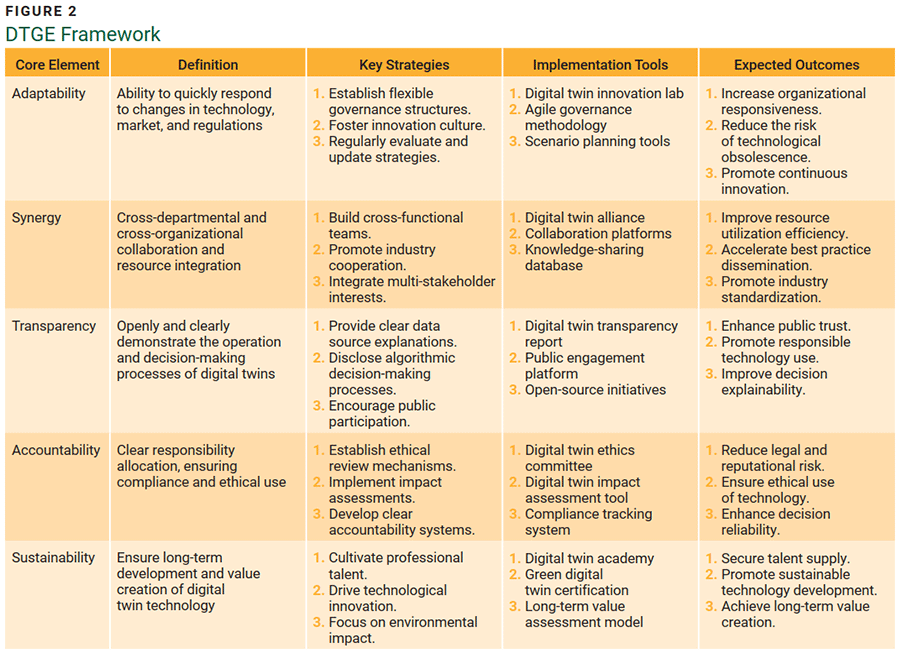
In particular, the implementation of the DTGE framework requires organizations to undergo a profound paradigm shift. Traditionally, rigid top-down governance models have been ill-equipped to manage complicated challenges. Organizations urgently need to foster a more open, flexible, and collaborative governance culture. Such cultural changes are often accompanied by obstacles such as organizational inertia and conflicts of interest. Therefore, the support and long-term commitment of top leaders have become a necessary condition. Leaders should be far-sighted and acknowledge that efficient digital twin governance is not only a means of risk mitigation, but also a key to creating long-term value. At the same time, when implementing the DTGE framework, enterprises must consider industry characteristics and organizational contexts. Given the diverse challenges and opportunities across industries, governance frameworks for digital twins should be customized to address sector-specific needs. For example, the healthcare sector is particularly concerned about data privacy and ethical issues, requiring a stronger focus on accountability and transparency. In manufacturing, interoperability and data quality are more critical and demand greater attention to synergy and adaptability. The flexibility of the DTGE framework ensures that it can adapt to the specific needs of different industries while maintaining consistency in its core principles.
Another significant feature of the DTGE framework is its forward-looking nature. With the advancement of technology, the application domains and complexity of digital twins expand constantly. In the future, cross-domain and cross-border digital twin applications will emerge, bringing more governance challenges. By emphasizing sustainability, the DTGE framework encourages organizations to keep learning, innovating, and adapting to prepare for future developments. To address the talent shortage, organizations and educational institutions are establishing digital twin academies—specialized training programs that combine theoretical knowledge with hands-on experience in digital twin technologies. These academies typically offer courses in data analytics, IoT, AI, and simulation techniques specific to digital twin applications. The concept of a digital twin academy not only helps meet current talent demand, but also reserves necessary human capital for future technological advancement.
It is essential to recognize that the DTGE framework is not a panacea. It is intended to be a dynamic guide that is adjusted and refined by organizations based on their specific situations and external environments. In practice, challenges such as resource constraints, technological barriers, and cultural resistance are inevitable. To overcome these obstacles, patience and perseverance are required from organizations, as well as collaborative efforts from the entire industry ecosystem. This process of continuous improvement and adaptation is the embodiment of the DTGE framework: Governance is a dynamic and ever-evolving process.
Looking forward to the future, when digital twin technology deeply integrates with innovative technologies, it may be necessary to further expand the DTGE framework. Issues such as how to achieve effective governance in a decentralized environment and how to balance the autonomy and controllability of AI are worthy of in-depth exploration. Especially with the popularization of digital twin technology in society, it is important to consider its social and ethical impacts, potentially incorporating more social responsibility and ethical considerations into the framework. These new challenges prompt not only continuous updating of the DTGE framework, but also a rethinking of the complex relationships between digital twin technology and society, economy, and environment. Through this process, the importance of interdisciplinary collaboration is self-evident.
Stakeholders should work together to explore new governance paradigms for the digital twin era. Only by such diverse collaborations will it be possible to build a comprehensive, effective, and forward-looking digital twin governance system, contribute to the healthy development of digital twin technology, and enhance social well-being.
Charting the Path Forward
To navigate the complex landscape of digital twin governance, the DTGE framework offers a robust foundation for organizations to build upon. The journey ahead necessitates adaptability and collaboration. Organizations must embrace a culture of innovation and flexibility, and dynamically refine governance approaches in response to technological advancements and societal changes. Interdisciplinary cooperation will be crucial, bringing together experts from technology, ethics, law, and policy to address emerging challenges. With the prevalence of digital twins, it is necessary to prioritize public engagement and education to ensure widespread understanding and acceptance of this transformative technology. Only by fostering a comprehensive, adaptive, and collaborative approach to governance will it be possible to harness the potential of digital twins, mitigate associated risk, drive innovation, and create sustainable value in an increasingly digital world.
Endnotes
1 Markets and Markets, “Digital Twin Market Size, Share, Statistics and Industry Growth Analysis Report by Application (Predictive Maintenance, Business Optimization, Performance Monitoring, Inventory Management), Industry (Automotive & Transportation, Healthcare, Energy & Utilities), Enterprise and Geography – Global Growth Driver and Industry Forecast to 2028,” 2023
2 Grieves, M.; “Product Lifecycle Management: The New Paradigm for Enterprises,” International Journal of Product Development, vol. 2, iss. 1/2, 4 April 2005
3 Shafto, M.; Conroy, M.; et al.; “Modeling, Simulation, Information Technology and Processing Roadmap,” National Aeronautics and Space Administration, USA, May 2010
4 Hearn, M.; Rix, S.; “Cybersecurity Considerations for Digital Twin Implementations,” IIC Journal of Innovation, November 2019
5 Crespi, N.; Drobot, A.T.; et al.; “The Digital Twin,” Springer, 2022
6 European Commission, “Proposal for a Regulation Laying Down Harmonised Rules on Artificial Intelligence | Shaping Europe's Digital Future,” European Union, 21 April 2021
7 Mihai, S.; Yaqoob, M.; et al.; “Digital Twins: A Survey on Enabling Technologies, Challenges, Trends and Future Prospects,” IEEE Communications Surveys & Tutorials, vol. 24, iss. 4, 2022
8 International Organization for Standardization (ISO)/International Electrotechnical Commission (IEC), ISO/IEC 30173:2023 Digital twin – concepts and terminology, 2023
9 Digital Twin Consortium, “Accelerating Digital Twin Innovation”
10 OPC Foundation, “4.1 Introduction to the Asset Administration Shell”
11 IEC, IEC 62541-5, 2020
12 Roland Berger, “The Digital Dilemma | Why Companies Struggle to Master Digital Transformation,” 2022
YANYI WU
Is a research associate with the School of Public Affairs and the Institute of China's Science, Technology, and Policy division at Zhejiang University (Hangzhou, China). His research interest lies in the areas of technology policy and governance, as well as artificial intelligence (AI) governance. He focuses on understanding the implications of emerging technologies on societal structures and developing frameworks for ethical implementation.
CHENGHUA LIN
Is a professor with the School of Public Affairs and the Institute of China's Science, Technology, and Policy division at Zhejiang University (Hangzhou, China). Lin has served as a consultant to Chinese government agencies on issues of technological development and governance.