
Innovation creates tension between opportunity and integrity. As an example, while artificial intelligence (AI) innovations can create opportunities, they can also introduce all manner of harm,1 including potentially damaging human lives at scale.2
The harm introduced by some existing innovations has already been significant. For example, electrical and electronic devices—many of which have proven utility, such as laptops and mobile phones—have already harmed both the environment and many communities by means of the soaring volume of toxic e-waste3 from decades of discarded, broken, or obsolete devices.
For ESG, both innovation and integrity seem to have fallen by the wayside, making way only for the desire to make money out of subjectively high-ESG-scoring enterprises.There is a need to better manage the tension created by the innovation–integrity dilemma in the interests of safe, meaningful, and sustainable outcomes for both people and planet. Managing this tension is key in the presence of business leaders who might otherwise pursue profit at any cost. The environmental, social, and governance (ESG) concept is an example of this tension; the tension between business opportunity and the management integrity needed to ensure that no environmental or social harms materialize in the process of pursuing the opportunity.
ESG used to be about doing good for the environment as a risk management strategy.4 However, goodness doesn’t sell, and ESG began to lose its way and have a questionable environmental and social impact when it became an investment paradigm5 in yet another case of making money trumping doing good. ESG today has “come down to investment and reporting.”6 This means that ESG has unfortunately itself become a business opportunity without the tension needed to ensure that any negative environmental or social impact is purposefully minimized.
ESG: Opportunity Lost
The principles behind ESG “… are decades, maybe even centuries, old,” depending on where one draws the line.7 There are also many allied concepts that laid the path to the current understanding of ESG, such as socially responsible investing (SRI), the Global Reporting Initiative (GRI), corporate social responsibility (CSR), and the Millennium Development Goals (MDGs), which became the Sustainable Development Goals (SDGs). The intent behind ESG—based on its predecessors, such as Safety, Health, Environment, Risk and Quality (SHERQ) and the Triple Bottom Line (TBL)—was to help lead enterprises toward more sustainable business practices.8
SHERQ emerged as part of workplace risk management.9 In the mining and manufacturing industries, the paradigm is often implemented with standards such as International Organization for Standardization (ISO) 900110 for quality and ISO 1400011 for environmental management.12 TBL was based on the idea that business is not only about profit, but also about an organization’s impact on the communities and environments in whichit operates.13
From an innovation perspective, the integrity half of the evolving ESG paradigm enabled various business opportunities as a counterpoint. For example, solutions to environmental integrity issues include renewable energy technologies and circular economy models, while solutions to social issues include creating innovative business models, partnerships, and outreach programs.14 Governance has also been subject to innovation, for example, by means of supporting and enabling platforms, data, and tools.
ESG ultimately evolved into a modern take on the socially responsible investing paradigm of the 1960s,15 with the theory being that enterprises with higher ESG ratings would attract more investment and produce higher investment returns by doing good (i.e., by ensuring the well-being of both the community and the environments in which those enterprises operated). In turn, ESG investors looked “to back companies that [were] … undergoing the necessary steps to reduce their carbon footprint.”16
But ESG is failing, not necessarily on the innovation front, but due to waning investor support for ESGs’ encapsulating construct as an investment paradigm. There is also no reliable evidence to support the assertion of higher investment returns from ESG,17 or even that socially responsible investments in general have ever yielded higher returns.18
Furthermore, it has been reported that there is also not much difference in an enterprise’s ESG performance—its impact on the environment, communities, or governance—because of the paradigm.19 That is because the money invested in ESG is to drive shareholder returns, not to invest in ESG challenges.20 There is a difference. Investors have even said that the ESG requirements can “get in the way of generating maximum returns on their investments.”21
There are many reasons for ESG not achieving its investment or sustainability goals, including:
- No standardization exists between ESG scores.22 Each rating organization has its own measurement methodology. So, an enterprise could score high on one organization’s rating, and low on another organization’s rating, leaving investors confused. The approach adopted by the EU’s 2019 Sustainable Finance Disclosure Mechanism might help address the issue of non-standardization.23
- ESG focuses on measuring internal processes (inputs or activities) rather than on the external impacts of sustainability initiatives (outcomes). With no focus on the environmental and community outcomes of those activities, the core of what makes ESG valuable is missing.
- Greenwashing to attract investments undermines the core principles of ESG.
- ESG is not integrated into the organization’s research and development (R&D) planning, thereby hampering innovation.24
- ESG is seen as merely a compliance activity.
For ESG, both innovation and integrity seem to have fallen by the wayside, making way only for the desire to make money out of subjectively high-ESG-scoring enterprises.
ESG: Opportunity Rediscovered
Abstracting ourselves from ESG’s integrity failure—the evolution of ESG doing good to ESG as a money—making machine—there are IT innovations not developed solely in response to ESG that have gained attention for ESG:25
- AI has the potential to enable emission reductions by 4% by 2030.
- IoT has the potential to reduce agricultural water waste by 50%.
- Blockchain is “essential for improving transparency and trust in ESG reporting,” according to more than half of reporting organizations.
While these innovations may play a role in doing good, they are not without their own integrity challenges. For example, the dilemma for AI is its significant energy demands;26 IoT can expose a network to security challenges and thus compromise privacy;27 and blockchain also has significant energy demands that have considerable negative environmentalimpacts.28 These technologies—and technologies like them—should thus be governed to ensure that they do not do more harm than good.
Green IT Best Practices
Perhaps inspired by ESG and similar movements, green IT is a computing paradigm where “(a) IT resource efficiencies are maximized, (b) resources … are re-used whenever possible, [and] (c) sustainable products and manufacturing practices are adopted.”29
Green IT is an interesting opportunity even for enterprise leaders focused only on profit. Who would not consider a stronger bottom line brought about by more efficient IT in sectors where the scale of IT is a significant part of their cost base? While no consideration might be applied by such leaders for the“… outsized impact on a company’s carbon footprint”30 given the scale of IT, green IT as an efficiency alternative would have the benefit of reducing the organization’s carbon footprint as a side-effect.
If this is insufficient motivation to pursue green IT, then the emerging regulatory issue of Power Usage Effectiveness (PUE)31 might be. PUE is important when one considers that data centers alone accounted for approximately 1% of the world’s total energy consumption in 2018, with roughly half of that consumed by servers, and about another half consumed by cooling and power managementsystems.32 Another source suggests this was as high as 3% at about the same time, and that it was expected to rise to 8% by 2030,33 all other things remaining equal. Even if the scale of energy consumption is of no concern other than for regulatory compliance, the growth rate in consumption might well be of concern for the sustainability of the organization over time. In this respect, some green IT best practices include:34
- Energy-efficienthardware—Prioritizing devices that are, for example, Energy Star-compliant
- Virtualization—Creating multiple server instances on a single machine
- Power management—For example, entering sleep or hibernation modes during inactivity
- Renewableenergy—Harnessing alternative power sources
- E-waste recycling—Refurbishing and redeploying older equipment in functions where the latest equipment is not necessary
- Sustainable softwaredevelopment—Software development with a resource-optimization focus
- Optimized data centers—Revisiting layout to maximize airflow
Today, cloud technology can be considered a green IT practice in the presence of some or all of “(a) resource management with virtualization, (b) sustainability with renewable energy and waste heat utilization, (c) and resource scheduling with state-of-the-art evolutionaryalgorithms.”35
However, these innovations have their own dilemmas. These include the risk of the unknown, potentially increased financial commitments of transitioning to green IT (versus the long-term benefits of reduced energy consumption), the cybersecurity concerns of cloud computing and poor application programming interface (API) management, and potential compatibility issues between green IT and the existing IT portfolio.36
Green IT Governance
Are IT governance approaches such as ISO/ International Electrotechnical Commission (IEC) 3850037 sufficient for governing green IT?
In 2008 it was suggested that the typical IT governance domains were sufficient to govern green IT.38 However, the requirements extended to the need for top management commitment and to identifying a champion for green IT, which are part of governance ingeneral(roles,responsibilities,andaccountabilities) and of change management (change leadership).
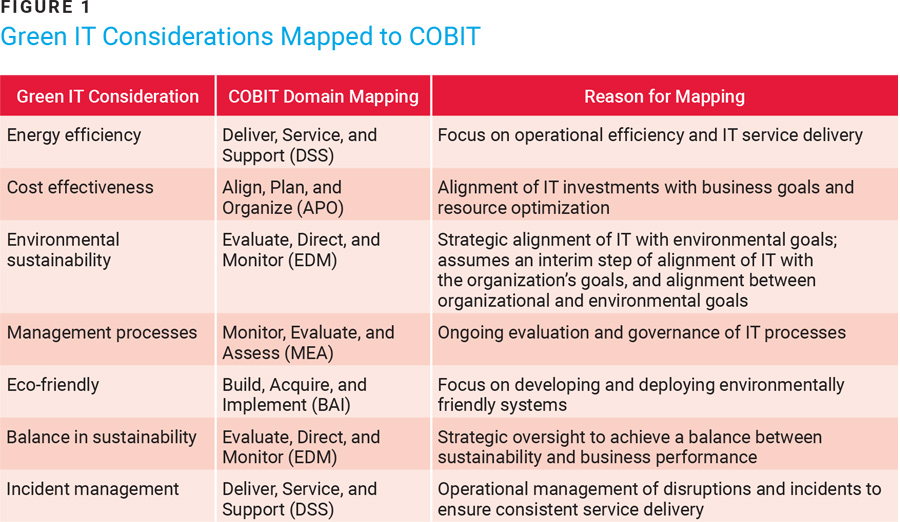
Furthermore, one study proposes that “[g]reen IT sees conventional IT as a problem that must be handled,”39 possibly to address the issues raised earlier. Another study treats green IT as an opportunity to address the environmental effects of technology.40 The latter perspective brings specific considerations for green IT into focus, including energy efficiency, cost effectiveness,environmentalsustainability,management processes, eco-friendliness, balanced sustainability, and incident management. It can be argued that all of these new considerations can be mapped to existing Certified in the Governance of Enterprise IT® (CGEIT®)41 or COBIT®42 domains.
Pursued for reasons such as organizational efficiency and long-term organizational sustainability, green ITcreates its own innovation—integrity dilemmas that demand active governance.For example, figure 1 maps the considerations for green IT against COBIT.
As another example, figure 2 maps the considerations for green IT against the CGEIT domains.
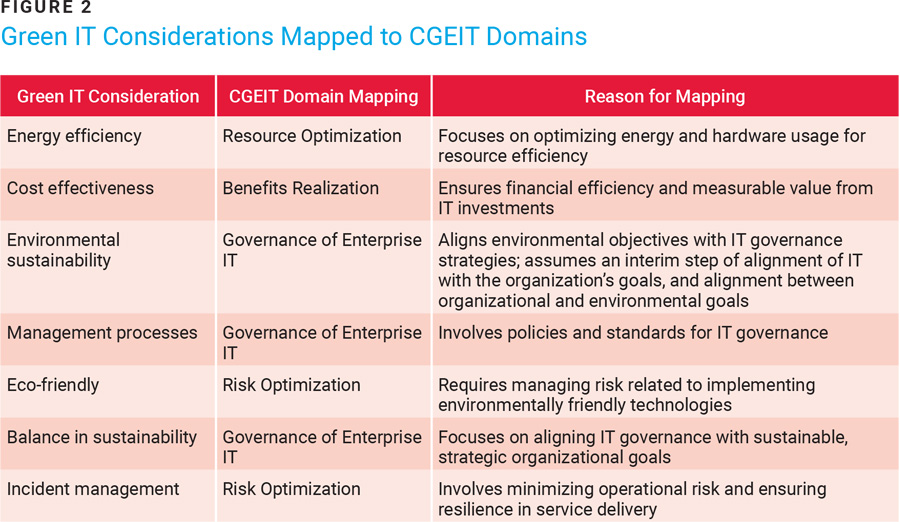
From figures 1 and 2, it becomes clear that the considerations for green IT governance map well to the existing CGEIT and COBIT domains. This means that existing frameworks may be sufficient to govern (mainly CGEIT) and manage (mainly COBIT) green IT.
Conclusion
ESG is a great example of the failure of the integrity portion of the innovation–integrity dilemma, as the focus often shifts to investor returns rather than actual environmental, social, and governance developments. Even the innovation half of the equation fails when ESG innovation does not become part of the organization’s R&D processes. Whereas ESG emerged as a paradigm for doing good, it ultimately failed when the paradigm became focused on profit instead.
Green IT is related to ESG in its original form. Pursued for reasons such as organizational efficiency and long-term organizational sustainability, green IT creates its own innovation–integrity dilemmas that demand active governance. Some propose that green IT contains new aspects and therefore a different approach to IT governance is required. These new aspects map sufficiently well to both the COBIT and CGEIT domains, suggesting that new domains are not currently required for the effective governance of green IT.
The reputation of ESG has been damaged to such an extent that one wonders whether it is salvageable or whether the next generation of doing good through environmentally beneficial innovations should be renamed. Either way, ESG in its purest form remains a noble pursuit with sufficiently abundant green shoots suggesting that doing good, even in information technology, is still very much alive.
Endnotes
1 Loeppky, J.; “32 Times Artificial Intelligence Got it Catastrophically Wrong,” Live Science, 16 June 20242 Littman, M.L.; Ajunwa, I.; et al.; Gathering Strength, Gathering Storms: The One Hundred Year Study on Artificial Intelligence (AI100) 2021 Study Panel Report, Stanford University, September 2021
3 Baldé, C.P.; Kuehr, R.; et al.; The Global e-Waste Monitor 2024: Electronic Waste Rising Five Times Faster than Documented E-waste Recycling, UNITAR, 2024, World Health Organization, “Electronic Waste (e-Waste),” 1 October 2024
4 Bedford Consulting, “How ESG, Innovation and Digital Transformation Are Intertwined”
5 Damodaran, A.; “ESG is Beyond Redemption: May it RIP,” Financial Times, 23 October 2023
6 Byrne, D.; “What Is the History of ESG?,” Corporate Governance Institute, 21 October 2022
7 Byrne; “What Is the History of ESG?”
8 Byrne; “What Is the History of ESG?”
9 IBM, “What Is Environment, Health and Safety (EHS)?,” 2 August 2023
10 International Organization for Standardization (ISO), ISO 9001 Quality management systems — Requirements, 2015
11 ISO, “ISO 14000 Family: Environmental Management”
12 Illingworth, V.; “Is it EHS, SHE, HSE, HSSE, SHEQ or OHS and What’s the Difference?,” ERM, 26 March 2021
13 Elkington, J.; “25 Years Ago I Coined the Phrase “Triple Bottom Line.” Here’s Why It’s Time to Rethink It,” Harvard Business Review, 25 June 2018
14 Bedford Consulting, “How ESG, Innovation and Digital Transformation Are Intertwined” 21 December 2023
15 MSCI, “The Evolution of ESG Investing”
16 Nathan, B.; “7 Key Benefits of ESG Investing,” Finance Alliance, 24 May 2024
17 Globerman, S.; Mintz, J.; et al.; “ESG Will Impose Considerable Harm on Canadian Workers, Doesn’t Reflect the Reality of How Markets Actually Work,” Fraser Institute, 28 August 2024
18 Porter, M.E.; Kramer, M.; et al.; “Where ESG Fails,” Institutional Investor, 16 October 2019
19 Bhagat, S.; “An Inconvenient Truth About ESG Investing,” Harvard Business Review, 31 March 2022
20 Pucker, K.P.; King, A.; “ESG Investing Isn’t Designed to Save the Planet,” Harvard Business Review, 1 August 2022
21 Snyder, S.A.; Macwan, S.; “The Missing Link Between ESG and Corporate Innovation,” Knowledge at Wharton, 13 March 2023
22 Logan, L.; “The Problem With ESG Scores,” Stewart Investors, April 2022, Nathan; “7 Key Benefits”
23 KPMG, “What is the SFDR?,” March 2021
24 Snyder; “The Missing Link”
25 Ramchandani, S.; “Innovative Technologies Paving the Way for ESG and Sustainability Success,” FT Insights, 12 August 2024
26 Zewe, A.; “Explained: Generative AI’s Environmental Impact,” MIT News, 17 January 2025
27 Office of the Victorian Information Commissioner, “Internet of Things and Privacy—Issues and Challenges,” Australian Government
28 United Nations University, “UN Study Reveals the Hidden Environmental Impacts of Bitcoin: Carbon is Not the Only Harmful By-Product,” 24 October 2023
29 Shuja, J.; Ahmad, R.W.; et al.; “Greening Emerging ITTechnologies: Techniques and Practices,” Journal of Internet Services and Applications, 2017
30 Lawton, G.; “13 Key ESG and Sustainability Trends, Ideas for Companies,” TechTarget, 2 August 2024
31 Lawton; “13 Key ESG”
32 Energy Innovation, “How Much Energy Do Data Centers Really Use?,” 20 March 2020
33 Pandey, S.K.; Singh, K.P.; et al.; “Green Computing: Importance, Approaches, and Practice,” Chapter in 6G Connectivity-Systems, Technologies, and Applications, 2024, River Publishers
34 InApp, “7 Green Computing Best Practices,” 29 September 2023
35 Shuja; Ahmad; “Greening Emerging IT Technologies”
36 Stevens, G.; “How to Promote Green Computing Practices,” namecheap, 30 May 2024
37 ISO and IEC, ISO/IEC 38500 Information technology—Governance of IT for the organization, 2024
38 De Graaf, C.; “In Search of Green IT Governance,” Trellis, 20 March 2008
39 Aini, N.N.; Subriadi, A.P.; “Governance and Practice Approach of Green Information Technology,” Procedia Computer Science, vol. 197, 2022, p. 650-659
40 Aini; Subriadi; “Governance and Practice”
41 ISACA®, CGEIT®
42 ISACA, COBIT®
GUY PEARCE | CGEIT, CDPSE
With an academic background in business, computer science, economics, and environmental science, Pearce has held senior leadership and governance roles in the private and public sectors on two continents. He has led digital transformations involving IT and data for most of his career, excelling in building sustainable enterprise capabilities enabling value delivery. An industry thought leader with more than 100 published articles, he was awarded the 2019 ISACA® Michael Cangemi Best Author award.