
At the Converge Africa conference in May 2025, Dr. Jeanne Fredericks explained that when beginners learn to play the piano, they are not immediately taught music theory, finger techniques, or posture in exhaustive detail. Instead, they learn to play a simple song early on, integrating techniques and methodologies as they progress.1
Data loss prevention (DLP) programs often take the opposite approach—months or years are spent developing governance structures, defining data owners, and building standard operating procedures (SOPs) before any real value is demonstrated. This leads to fatigue, loss of momentum, and ultimately a lack of business support and investment.
Instead, DLP initiatives should start with a practical use case, i.e., “play a song,” to deliver value early. Governance should evolve iteratively and not be rigidly defined from day one. This allows the organization to manage risk while continuously demonstrating value.
While organizations may adopt various cybersecurity strategies, protecting data remains central. Therefore, a well-defined data security strategy is fundamental. According to IBM’s Cost of a Data Breach Report 2025, the global average cost of a data breach is US$4.4 million.2 DLP is not just a technology deployment; it is a holistic program that integrates people, processes, and technology to safeguard digital assets. The objectives of a DLP program are to prevent identity theft, ensure regulatory compliance, protect the organization’s reputation, and safeguard intellectual property. Presented here is a pragmatic framework for implementing DLP and increasing its chances of success.
Strategic Considerations
Treating DLP as a technological project will cement the view that it is a technology-related issue, which may make it challenging to get business stakeholders to take ownership. There are three strategies to overcome these challenges:
- DLP must be positioned as a business imperative.3 The risk must be communicated as such, e.g., by highlighting the potential for regulatory penalties, lawsuits, or reputational damage. Furthermore, the value to the organization must be articulated, which might include increased resilience, compliance, or trust.
- It is important to involve the right stakeholders at the right stages. Failing to define clear roles and responsibilities may result in the exclusion of key stakeholders.4 However, overinvolvement also has the potential to cause issues, as it can lead to disengagement.
- Attempting to protect all data equally goes against the principles of risk-based security and often results in unnecessary cost and complexity. DLP, by nature, is complex and costly.5 A data discovery and risk assessment should be conducted early in the process to ensure that all investment decisions are guided by risk and accurate insights into data exposure.
While the aim of the project should be iterative value—i.e., to “play a song”—there are important considerations that must precede the adoption of DLP technology.
Why DLP Projects Fail
DLP projects often fail to provide the protection they should for organizations; in fact, there are claims that more than two-thirds of DLP projects fail.6 With that in mind, it is worth examining some of the common reasons DLP initiatives fail and how to navigate those pitfalls.
Strategic Failures
At the highest level, DLP projects fail because they are perceived as technology initiatives focused on preventing data exfiltration rather than as business imperatives focused on safeguarding enterprise processes and avoiding regulatory penalties. The primary contributors to strategic failures in the context of DLP projects are:
- Inadequate stakeholder involvement—It is common for cybersecurity or data privacy teams to drive DLP projects. However, effective DLP implementation requires involvement from multiple departments—and most important, from business leaders. The correct stakeholders must be identified, educated, and engaged at the appropriate stages.7
- Insufficient organizational change management—DLP technology is intrusive by design, and business processes must be adapted to support new workflows and handle policy violations. Education and communication should emphasize why DLP is necessary and how it protects both employees and the organization.
- Lack of project and post-project support—Despite careful planning, most DLP implementations will at some point impact business operations negatively. Ensuring that the project team is available to attend to issues immediately is essential to avoid withdrawal of support for the DLP program.
Process Failures
When a DLP system detects a policy violation and generates an alert, the importance of well-defined processes immediately becomes evident. Who should receive the alert? How should they respond? These questions must be addressed through the process component of the program.
Examples of common process failures include:
- Undefined use cases and data handling procedures—A lack of clearly defined use cases and data handling procedures at the outset can result in undetected policy violations or, worse, ignored alerts. Alignment is only possible when processes are well understood and consistently maintained.
- Failure to map data flows—Without a clear understanding of how data moves through the organization, it is impossible to define effective DLP policies. Data classification levels, movement paths, and user access requirements must be identified to design policies that are both practical and enforceable.
- Neglecting to monitor changes—Policies must be continuously reviewed and adjusted to remain relevant in a constantly evolving IT and business landscape.8
Technology Failures
In the context of a DLP program, the technology deployment and enforcement phase is where the rubber meets the road. A failed implementation typically results in one of two outcomes: a disruption of business processes or a failure to prevent data loss.
Common technical failures include:
- Loosely connected components create administrative overhead and hinder comprehensive monitoring, leaving data exfiltration points exposed. The chosen solution must provide tight integration across endpoints, networks, and storage to ensure unified coverage and visibility.
- Overly strict policies often lead to excessive false positives, overwhelming users and risking alert fatigue. Depending on the policies configured, this could also lead to business disruption.9
- Technical solutions must be evaluated on their ability to handle encrypted traffic. DLP solutions cannot inspect encrypted traffic unless they operate as a man in the middle (MiTM). Without this capability, critical exfiltration vectors may go undetected. However, some applications break when MiTM inspection is detected.
- Regular expressions can be unreliable. Similar-looking data types (e.g., phone numbers vs. customer IDs) and obfuscation tactics (e.g., spelling out numbers) can easily bypass detection. It is important to look for technical solutions that offer content analysis and ideally incorporate artificial intelligence (AI) to reduce false positives and bypasses.
- Technology vendors will not know organization-specific identifiers such as employee numbers or customer codes.10 Hence, there may be a need to define these patterns and their format, length, and validation rules to ensure effective monitoring. Some solutions lack custom pattern definition, or if they do support it, it is complex to configure.
- If the DLP solution does not utilize machine learning (ML) or behavioral analytics, its effectiveness is limited to static, predefined rules.
Architecture guiding principles should inform the choice of technology.11 Considerations such as cloud vs. on-premises, integration points, modules, and compatibility with existing solutions must be accounted for.
A DLP program must be supported by a comprehensive strategy for user education and ongoing awareness. After all, the human element remains the most vulnerable—and most frequently exploited—aspect of security.Partner Failures
Vendors and partners should be thoroughly vetted for both technical capability and strategic alignment. It is important to ensure that contracts include clear service level agreements (SLAs), measurable outcomes, and well-defined exit clauses, and to engage with current and former clients to assess a vendor’s credibility and performance. Importantly, DLP advisory services should be separate from technology providers. A strategic advisor should not be the same entity selling the technology.
People Failures
Without a strong DLP training and awareness program, users may unknowingly violate organizational policies. Therefore, a DLP program must be supported by a comprehensive strategy for user education and ongoing awareness. After all, the human element remains the most vulnerable—and most frequently exploited—aspect of security.12
DLP Framework: A Structured and Practical Approach
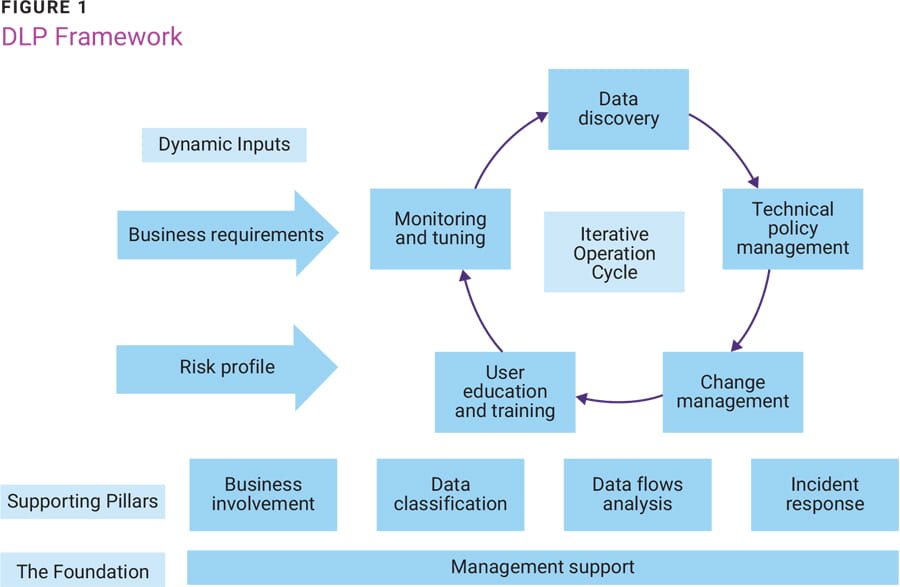
Implementing an effective data security program requires strategic alignment, business engagement, and a realistic understanding of organizational needs and limitations. The framework illustrated in figure 1 provides a structured approach to successfully implementing a DLP capability.
The Foundation
At the core of the framework is management support. A DLP program is likely to impact a number of business processes; therefore, securing upfront buy-in from senior management is imperative. The expected work effort, resource and investment requirements, and common organizational challenges must be transparently communicated to ensure that expectations are managed appropriately.
Supporting Pillars
To enable and sustain a DLP program, there are four strategic pillars that must be in place.
Business Involvement
Senior stakeholders (who have a good understanding of business processes) from all relevant departments should be involved. Data owners and data custodians must be identified, and the first iteration of change management and education should commence. Care must be taken not to overinvolve business stakeholders or draw them into technical discussions. Failing to manage this balance can lead to confusion, frustration, and eventual disengagement.
Data Classification
The key output of this step is a data classification and handling standard. All data types within the organization must be identified and classified accordingly.
An important part of this process is the definition and acceptance of a data classification matrix. This matrix can be as simple as four levels—public, internal, confidential, and secret—or as detailed as needed. However, simplicity is recommended and using more than four classification levels is generally discouraged, as it can lead to unnecessary complexity.13
Data Flow Analysis
The purpose of this step is to determine what confidential or sensitive information the organization collects and to ensure that it is handled properly by identifying potential weaknesses or regulatory violations. The analysis and map provide a clear reference point when defining technical policies and business rules.
Incident Response Process Definition
At this point, a common mistake is to proceed directly with implementing and enforcing technical policies.
This will result in situations where there is a policy violation but no defined process to respond to it. For this reason, the correct next step is to define incident responseprocedures.
Maintaining trust in the project team and the technology is essential. Without it, business leaders may withdraw their support and view the initiative as ineffective or disruptive to business operations.At a high level, there are two types of incidents that may arise: cyberincidents or business user violations. Procedures must exist for handling both types of incidents. The cybersecurity team will naturally respond to cyberincidents, but incidents involving business users are often more complex, requiring careful planning and clear processes. The procedures must address scenarios where a user sends, or attempts to send, confidential data externally. This could be malicious, or it could be legitimate but blocked due to an overly broad or incorrect policy.
It is crucial to define who receives these alerts and how each incident is handled. The feedback loop to refine and optimize policies in the case of false positives is equally important to avoid repeatedly involving stakeholders unnecessarily.
The problem with a learning mode approach is that it generates unmanageable volumes of alerts that cannot be meaningfully analyzed or acted upon.Iterative Operations Cycle
The operational activity cycle is an iterative component of the DLP project, driven by evolving inputs.
Data Discovery
Data discovery is the technical step of identifying where confidential data resides,14 as defined by the data classification and handling standard. The scope of this exercise should include endpoints, mobile devices, cloud environments, and email systems. The output is a report detailing all repositories and
discovered data, organized by classification.
A key consideration at this stage is the detection method. Static approaches that rely on regular expressions have limitations, as they simply search for pattern matches. More advanced methods use content analysis to scan data for known characteristics, often incorporating ML or AI.
The most important activity in this phase is managing false positives. Time must be allocated to validate and fine-tune detection rules, as continuing with a large volume of misclassified data can damage the program’s credibility. Maintaining trust in the project team and the technology is essential. Without it, business leaders may withdraw their support and view the initiative as ineffective or disruptive to business operations.
Technical Policy Management
This step involves creating and updating technical policies to ensure alignment with business requirements and objectives. At a basic level, a technical policy might, for example, prevent all users in the organization from emailing or uploading any document containing credit card information—except
for the finance department, which has a legitimate business need to share this information with banks as part of a reconciliation process.
It is inevitable that some valid data flows will be blocked during this step, which may temporarily disrupt business operations. To manage this effectively, ensure that the DLP team is easy to contact, users know how to report issues, and response times are quick. Delays in resolving operational issues will negatively affect the project’s reputation and can undermine business buy-in and support.
Change Management
A DLP implementation, unlike an endpoint detection and response (EDR) solution, requires significant consultation with business stakeholders. Business stakeholders play an ongoing role, as they need to respond to policy violations when they occur.
Without clear communication, training, and stakeholder engagement, DLP policies can disrupt business operations and lead to frustration. Effective change management builds understanding and ensures accountability. This can be as simple as hosting awareness sessions or as formal as adopting a structured framework such as Awareness, Desire, Knowledge, Ability, and Reinforcement (ADKAR),15 depending on the organization’s size and overall complexity. The important part is to view change management as ongoing and not a one-off activity.
User Education and Training
Various training campaigns, tailored to different job functions and delivered through multiple mediums, should be implemented. These must include general topics and content for all users, as well as role-specific training for high-risk user groups. Related policies and standards, such as data classification
and handling standards, must be incorporated into the training program to ensure that users are aware of organizational standards and policies, understand their content, and know where to access them.
Training should include practical and task-focused content. If users are expected to classify documents using a solution, they must be trained in the specific solution. If the cyberteam is expected to investigate policy violations, they must be trained in the response procedure. Training should be hands-on and reinforced by clear documentation and ongoing support.
Continuous Monitoring and Tuning
This step is important to ensure the ongoing effectiveness of the program and solution. This can be achieved by continuously analyzing recent alert data to identify patterns of false positives and false negatives. Another method is to conduct controlled test scenarios (e.g., simulating the exfiltration of sensitive data through known blocked channels to validate that policies and alerts are working as expected). Rules should be adjusted and retested when gaps are identified.
Phased Approach to Managing Operational Risk
A key principle to keep in mind when using the framework is the importance of phasing the deployment. Many organizations adopt the flawed strategy of implementing enterprisewide policies and operating in ‘learning mode’ for a period. The problem with a learning mode approach is that it generates unmanageable volumes of alerts that cannot be meaningfully analyzed or acted upon. A better approach is to start with a single department or business process, maturing policies and incident response procedures before expanding to other areas. By limiting scope, organizations can more effectively identify issues and fine-tune alerts.
Adopting a Use Case-Driven Approach
When use cases are identified upfront, it forces organizations to define their requirements and consider the solution within the practical context of the organization. It is important for use cases to have corresponding test cases and clear success criteria. Two sample use cases are illustrated in figure 2.
Figure 2—DLP Solution Use Case Examples
| Use Case | Test Cases | Success Criteria |
|---|---|---|
| Ensure compliance with the Payment Card Industry Data Security Standard (PCI DSS)16 by protecting payment card information. | • Upload files containing anonymized, format-preserved credit card information to a cloud storage platform. • Attempt to email anonymized, format-preserved credit card information to an external recipient. |
• The DLP solution should accurately alert, block, or encrypt the credit card information according to the implemented policy. • Detailed compliance logs should be generated for auditing purposes. • Alerts must be sent in real time to the defined recipients. |
| Attempt to transfer sensitive data outside the organization via email, USB devices, orunauthorized applications. | • Transfer sensitive files using unauthorized File Transfer Protocol (FTP) or Secure Shell (SSH) channels. • Copy sensitive files to a USB drive. • Upload data to an external server using anunapproved application. |
• The DLP solution should detect and block any transfer attempts. • Logs should be recorded that indicate the channel, user, and type of data involved in the attempt. • Alerts must be sent in real time to the defined recipients. |
Event Logging as an Enabler for Data Protection
To fully protect against data exfiltration, it is important to understand that data can be exfiltrated through various channels (figure 3).
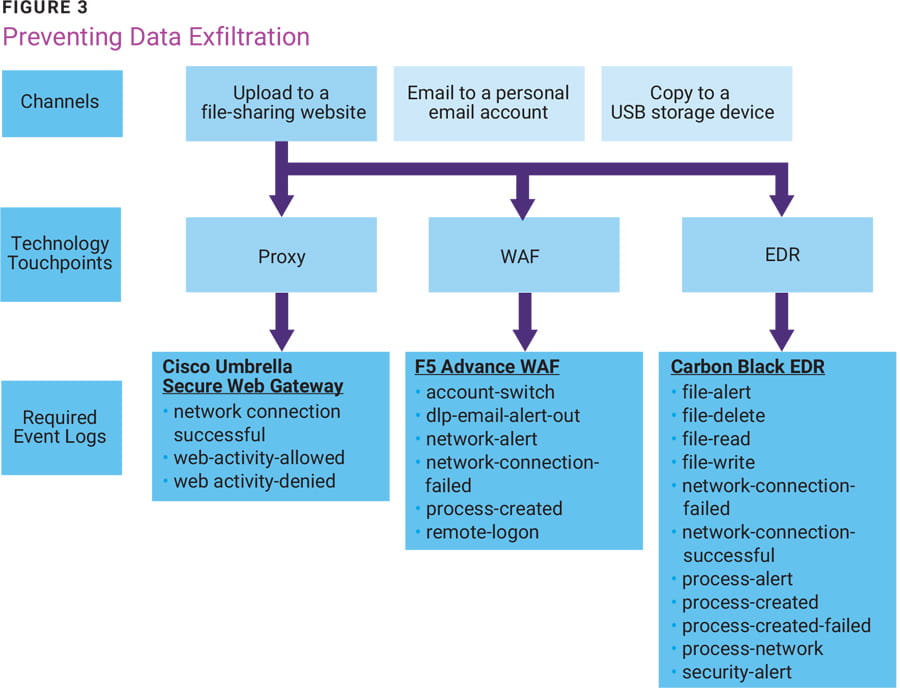
For each of these channels, the technology touchpoints must be identified and the appropriate event logging must be enabled. Only if this mapping is done correctly will the overarching DLP platform be able to accurately detect and prevent policy violations.
In this example, if a user or malicious actor uploads a sensitive file to an external file share, the web proxy, web application firewall (WAF), and endpoint will each record parts of that transaction. It is crucial for the correct granularity of logging to be enabled across all technology touchpoints.17
Conclusion
DLP deployments demand significant investment—time, money, and effort—and the risk of business disruption is real. That is exactly why starting with a clear, structured approach is so important. But structure alone is not enough.
If the goal is to “play the song”—to protect data effectively—then the sooner an organization starts playing, the sooner they can learn, adapt, and refine their approach.
By starting small, delivering quick wins, and letting governance mature alongside real-world progress, an organization will be far more likely to keep the momentum, secure ongoing support, and ultimately achieve the true goal: safeguarding its most valuable information assets.
Endnotes
1 Converge Africa, 2025
2 IBM, Cost of a Data Breach Report 2025, 2025
3 IANS Faculty, “How to Approach DLP as a Process to Drive Business Value,” IANS, 9 August 2024
4 Strac, “Data Loss Prevention Roles and Responsibilities,” 9 September 2024
5 Boehm, J.; Curcio, N.; et al.; “The Risk-Based Approach to Cybersecurity,” McKinsey & Company, 8 October 2019
6 Actifile, “WhyTraditional DLP ProjectsTend to Fail,” 14 December 2022; Vaideeswaran, N.; “Five Reasons Why Legacy Data Loss PreventionTools Fail to Deliver,” Crowdstrike, 23 October 2023
7 Pritha, “Top 6 Reasons Why Data Loss Prevention (DLP) Implementation Fails,” 10 February 2016
8 Farmer, D.; “7 Steps to Create a Data Loss Prevention Policy,” TechTarget, 19 April 2024
9 Polymer, “Top 7 DLP Fails,” 20 September 2021
10 Polymer, “Top 7 DLP Fails”
11 McDermott, R.; “Technology Governance with Architecture Principles,” Medium, 30 December 2024
12 Coker, J.; “95% of Data Beaches Tied to Human Error in 2024,” Infosecurity Magazine, 11 March 2025
13 Bendoraitis, N.; “ISO 27001 Data Classification: Levels Explained and Policy Template Guide,” CyberUpgrade, 10 June 2025
14 Murphy, D.; “The Role of Data Classification in Data Loss Prevention (DLP),” Lepide, 20 December 2024
15 Prosci, “ The Prosci ADKAR Model”
16 PCI Security Standards Council, PCI DSS: V4.0, https://docs-prv.pcisecuritystandards.org/PCI%20DSS/Standard/PCI-DSS-v4_0.pdf
17 Hughes, G.; “Log Management as an Enabler for Data Protection and Automated Threat Detection,” ISACA Journal®, vol. 4, 2023
GRANT HUGHES | CISA, CISM, CDPSE, CASP, CCSK, CCSP, CEH, CIH, CISSP, SSCP
Is a head of cybersecurity at Engen Petroleum Ltd. He is a strategic thinker, thought leader, and public speaker with a background in security strategy, architecture, cybersecurity risk, and security operations. Hughes has delivered multiple keynotes and has more than 14 years of experience in IT, eight of which have been spent in information and cybersecurity. He is a trusted advisor certified in many disciplines within the information security domain. He can be contacted on LinkedIn.