


In the past, compliance was a calendar-driven activity. Organizations would schedule internal audits, assemble mountains of documentation, and pass a point-in-time review. Once complete, the team would often exhale until the next cycle. That model is no longer sustainable. In a cloud-first, multi-jurisdictional world, regulations such as the General Data Protection Regulation (GDPR), Payment Card Industry Data Security Standard (PCI-DSS), and California Consumer Privacy Act (CCPA) demand continuous vigilance.
Continuous assurance is a paradigm move since compliance is consolidated as a constant state of operation instead of an annual milestone. This is an innovative method, which is driven by technologies like artificial intelligence (AI), robotic process automation (RPA), and cloud security posture management (CSPM), that allows businesses to identify, react, and demonstrate compliance in real-time.
Why Continuous Assurance Is No Longer Optional
From Static Compliance to Dynamic Oversight
Static compliance supposes that the environment in which the audit takes place will stay the same during the two audits. However, cloud environments are changing minute by minute. Developers launch new instances, implement applications, and alter configurations, sometimes without a security designation. Every alteration can hide a compliance gap that would not be noticed until the second audit. Constant assurance reverses this risk profile by gauging and sustaining compliance continuously.
The Global Regulatory Pressure
Regulatory authorities are increasing the coverage and application of compliance regulations, such as GDPR, PCI-DSS and CCPA. One infringement can cost millions of dollars, cause reputation loss, and cause loss of consumer confidence. Who knows how long it can take to fix that reputation? Within such a climate, compliance should no longer be a checkbox area, but rather an entrenched, quantifiable element of daily operation.
Figure 1: The Shift from Periodic Compliance to Continuous Assurance – Timeline Chart
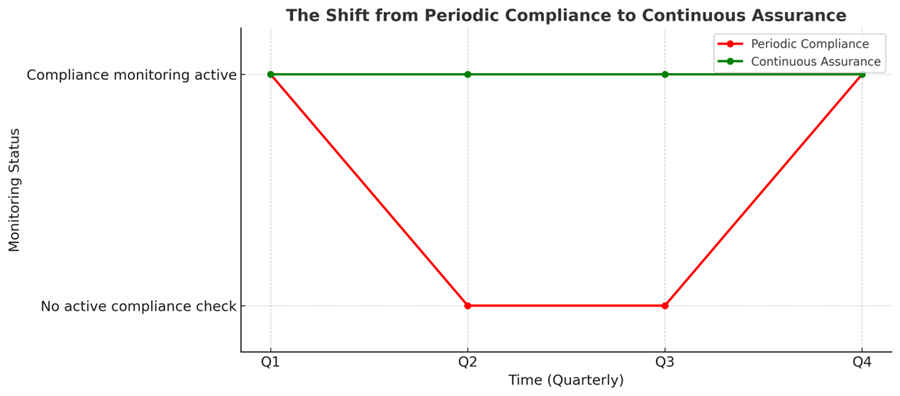
The red line depicts the periodic compliance, where only Q1 and Q4 are actively checked, leaving Q2 and Q3 non-observed. The green line is continuous assurance, with no lapses in monitoring between Q1 and Q4. This constant method will help remove blind spots, resulting in regulatory compliance and quick action throughout the year.
AI’s Role in Continuous Compliance Monitoring
Real-Time Anomaly Detection
AI-driven analytics tools can process billions of events in real-time, and irregularities can be detected, including high file downloads, abnormal access time to files, and configuration changes not authorized by the user. These anomalies can initiate automated warning and remediation processes before becoming a regulatory non-conformance.
Predictive Risk Assessment
Through historical compliance breaches, the AI models can predict where the breakdowns are most likely. For example, when there is a history of specific problems (such as improperly configured encryption) in a particular cloud environment, the AI system can raise the frequency of monitoring these systems.
Automated Policy Enforcement
AI can parse the meaning of policies and infer their application across large infrastructures. When creating a storage bucket without encryption, the AI system can perform that action immediately, encrypt the data, record it, and log it as compliance evidence.
Table 1: AI Applications in Cloud Compliance – Use Case, Technology, Compliance Benefit, Example Tools
| Use Case | Technology | Compliance Benefit | Example Tools |
|---|---|---|---|
|
Real-Time Anomaly Detection |
Machine Learning (ML) algorithms in SIEM systems | Detects unusual activities and configuration changes instantly | |
|
Predictive Risk Assessment |
AI-based predictive analytics models | Identifies likely compliance failures before they occur | |
|
Automated Policy Enforcement |
AI-driven orchestration and automation platforms | Applies security policies automatically across cloud environments | |
| Natural Language Processing for Policy Review | NLP engines to analyze compliance documentation | Accelerates policy mapping and gap analysis | |
| Compliance Reporting Automation | AI-powered BI and dashboard tools | Generates regulator-ready reports quickly and accurately |
Practical Application:
Organizations can utilize AI-driven monitoring in their current SIEM solution framework, e.g., Splunk or Azure Sentinel, to collect and inspect configuration events across AWS, Azure, and GCP in parallel. The more historical configuration and access logs fed into the AI engine, the more accurate its predictive ability is. It can be set up that when an unencrypted S3 bucket or Azure Blob is found, the AI engine can do the encryption immediately and record the repair action in the compliance evidence.
RPA as the Compliance Workhorse
Evidence Collection Without the Pain
Audit readiness can involve producing the proper evidence at the right time. RPA robots can export system configurations, report generation, and time-stamped screenshots. This alleviates the research load of redundant evidence collection by human teams.
Multi-Framework Control Mapping
One control may cover several frameworks, e.g., encryption at rest. RPA will be able to detect and cross-map such controls, and thus any evidence of one framework can be used in another, although it will save many hours of repetitive handwork.
Audit Trail Automation
All RPA bot actions are recordable and time-stamped, making an unalterable audit trail. This assists in both internal control and external audit.
Practical Application:
Implement RPA bots in your compliance workflows to collect daily GDPR-related audit evidence from CRM platforms and HR systems. Configure these bots to tag each artifact with control IDs and store them in a secure, version-controlled SharePoint repository. In the case of PCI-DSS, one can scan and fetch the encryption key rotation logs using the same bot against the payment gateway API and automatically match this with the missing CCPA and GDPR clauses to avoid duplicating efforts.
CSPM: The Continuous Posture Engine
24/7 Posture Visibility
CSPM tools give a single-pane-of-glass visibility into cloud settings, pointing out which areas are not aligned with set baselines or compliance demands.
Instant Remediation and Alerting
In cases where a policy violation is revealed, e.g., an unauthorized person gains access to a storage container, CSPM can execute a quick remediation script or refer the problem to a security team.
Multi-Cloud Governance
As organizations adopt AWS, Azure, and Google Cloud concurrently, CSPM ensures consistent security baselines across all platforms.
CSPM is powerful because it allows organizations to keep comparing their cloud settings with the industry’s best practices and regulatory compliance. Through automation of such comparison, CSPM tools also offer real-time insight into misconfigurations that would otherwise remain undetected. This active management avoids drift of compliance in multi-cloud operations, where the difficulty for teams is frequently enforcing consistent policies due to their complexity. Consequently, CSPM is not only enforcing but also enhancing the overall security posture of this organization.
Practical Application:
Configure your CSPM tool, such as Prisma Cloud, AWS Security Hub, or Microsoft Defender for Cloud, to run compliance scans every 30 minutes across all active cloud accounts. Design a rule that automatically isolates storage instances that are publicly exposed until the security group reviews them. Incorporate these alerts into a SOAR platform and have them auto-assigned to the relevant engineer, with resolution SLAs in real-time.
Practical Integration Strategies
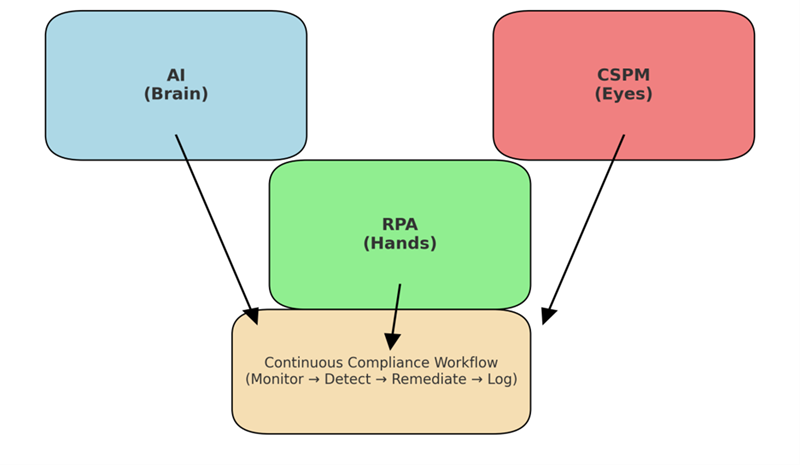
It is essential to have AI, RPA, and CSPM come together rather carefully. In a single compliance workflow (Figure 2), AI may act as the analytical brain that interprets the live signals and analyzes the anomalies. RPA is the hands that automate the routine evidence collection and documentation. CSPM serves as the eyes and scans the environment to find misalignments.
The presence of an integrated approach indicates that upon the detection of a misconfiguration, the error shall be rectified, documented, and logged, and is available for audit inquisition.
Figure 2: Integrated Continuous Compliance Architecture
Preparing for the Future of Cloud Compliance
Continuous assurance systems should be adaptable as regulatory structures change and new laws come into play. AI models can and must be retrained periodically, RPA processes must be revised to accommodate new evidence demands, and CSPM baselines must also be revised to address new services that may be made available.
Companies that learn to embrace this agility will minimize compliance risk and establish a trustworthy reputation and demonstrate that their operations are outstandingly well performed, making compliance a competitive differentiator rather than a hassle.
Compliance as a Trust Accelerator
Continuous assurance, which AI, RPA, and CSPM drive, converts compliance into an ongoing, proactive procedure. It helps organizations exceed and sometimes achieve the expectations of regulators, customers, and partners. The fiercely competitive cloud world is a fast-paced environment where nothing but evidence matters. The capability to provide that evidence immediately, and on an ongoing basis, is no longer an option but rather the cornerstone of sustainable success.
Continuous assurance also narrows the role of compliance, as a burden that is seen to create business value. Complying with the regulations included in the daily processes helps the organization pay less in auditing, minimize downtime in its processes, and create a real-time situation that will help in an improved decision-making process. Transparency and reliability introduced by such a model improve the brand reputation, gain customers, and develop a sustainable competitive advantage.
About the Author:
Omotayo F. Salako, CISA, is an experienced IT risk governance professional with over seven years of expertise in cybersecurity, internal audit, and risk management. She has a strong background in identity and access management (IAM), ITGC SOX testing, and risk assessments, and has supported critical cybersecurity initiatives while enhancing compliance frameworks.
Salako is an ISACA Social Media Advocate, a dedicated volunteer mentor actively contributing to the growth of the next generation of cybersecurity professionals, and serves as a peer reviewer for the ISACA Journal and multiple IEEE conferences. She is also a nominee for the 2025 Innovation in AI-Driven Audit Award.
