Interstellar, directed by Christopher Nolan and starring Matthew McConaughey and Anne Hathaway, is a cinematic tour de force. It explores the vastness of space, the complexities of human emotion, and the boundaries of scientific discovery. Beyond its gripping storyline and stunning visuals, Interstellar unveils a treasure trove of insights that deeply resonate with the challenges and opportunities of the digital age. The wisdom imparted by McConaughey's character, Cooper, and Hathaway's character, Brand, as they navigate the cosmos, parallels the pressing issues of sustainability, the evolving role of artificial intelligence (AI), and the importance of human resilience in the face of technological advancement.1
In Interstellar, viewers encounter a future Earth ravaged by environmental degradation, forcing humanity to seek new horizons beyond our planet. This narrative reflects the pressing challenges of today, as outlined by environmental, social, and governance (ESG) frameworks. Just as Cooper and Brand venture into the unknown to secure a future for humanity, we too must explore innovative solutions within the ESG framework to ensure the longevity of our planet.
Furthermore, Interstellar delves into the ethical and practical implications of AI through the portrayal of advanced robots such as TARS and CASE. These AI companions, possessing distinct personalities and capabilities, highlight the potential of AI to enhance decision making and provide reliable support during critical missions. However, the film also raises ethical dilemmas, as AI models must navigate difficult decisions, prompting questions about moral responsibility and the risk of over-dependence on technology. This duality showcases the complexities of integrating AI into daily life. The film prompts us to consider the balance between leveraging AI for progress and maintaining ethical boundaries. The relationship between humans and AI in Interstellar serves as a powerful metaphor for our contemporary quest to harness AI’s benefits while safeguarding humanity.
Beyond ESG and technological themes, Interstellar also celebrates the resilience of the human spirit. The characters' unwavering determination to overcome insurmountable odds and their ability to adapt to rapidly changing circumstances provide valuable lessons for navigating the complexities of the digital age. In the face of unprecedented technological advancements and societal shifts, the film’s depiction of perseverance and innovation becomes especially relevant. McConaughey and Hathaway’s performances bring to life the emotional and intellectual fortitude required to thrive in an ever-evolving world.
There is much to be gained by unpacking the profound messages embedded in Interstellar and exploring how they can guide practitioners in addressing contemporary challenges. By examining the film through the lens of McConaughey and Hathaway's characters, a deeper understanding of the intersection between cinematic storytelling and real-world issues can be reached.
While short-term solutions are necessary, they are insufficient without a long-term vision for sustainability.The Quest for Sustainability
In Interstellar, the quest for sustainability is a driving force of the narrative. The film is set in a future where Earth is on the brink of collapse due to severe environmental degradation, with blight and dust storms threatening humanity's survival. This dire situation prompts the search for a new habitable planet, highlighting the critical importance of sustainable practices to ensure the continuity of human life.
A pivotal scene that illustrates this theme is when Cooper attends a parent-teacher conference and learns that the government has decided to abandon space exploration to focus on immediate agricultural concerns. This scene underscores a key message: While short-term solutions are necessary, they are insufficient without a long-term vision for sustainability. In the IT sector, this translates to the necessity of balancing immediate technological needs with long-term sustainable practices.
The information and communication technology (ICT) sector significantly impacts the environment, contributing approximately 2-3% of global carbon emissions2 and 50 million metric tons of eWaste annually.3 This environmental footprint underscores the urgent need for sustainable ICT practices and effective eWaste management.
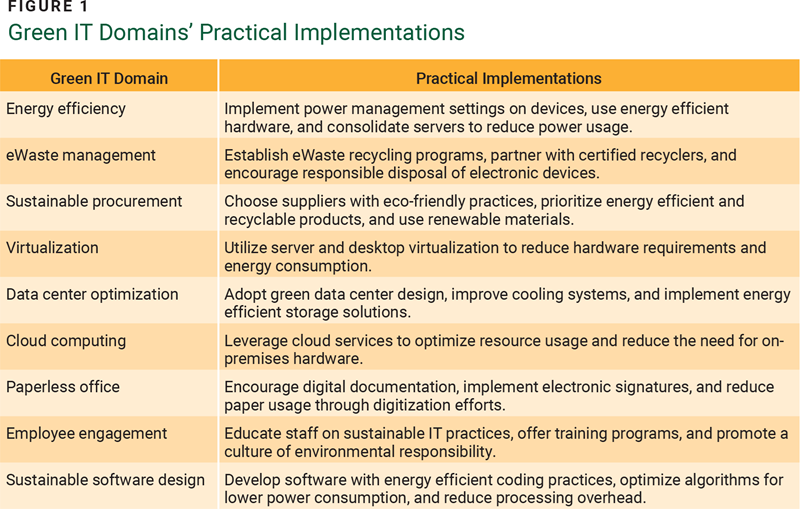
A compelling example of integrating sustainability into IT practices comes from the IT company, HP. The company has set an ambitious goal to recycle 1.2 million tons of hardware and supplies by 2025. As of 2022, HP had already recycled 879,100 tons of hardware and supplies, demonstrating its commitment to sustainability.4 By providing biodegradable recycling bags and partnering with environmental organizations to plant trees based on customer recycling efforts, HP demonstrates how sustainability can be woven into daily operations. For IT departments, adopting similar practices—such as implementing eWaste recycling programs and choosing eco-friendly suppliers—can significantly reduce environmental impact while promoting long-term efficiency.
By adopting sustainable practices (figure 1), IT departments can significantly contribute to a greener future while optimizing their operations.
Wormholes of Innovation
While the quest for sustainability highlights the importance of addressing immediate challenges, it also emphasizes the need for innovative solutions that can redefine the future. In Interstellar, wormholes symbolize gateways to new, uncharted territories, representing the potential for groundbreaking discoveries and advancements. The film’s protagonists, faced with the daunting challenge of saving humanity, must navigate through these wormholes, embracing the unknown and leveraging innovative solutions to overcome seemingly insurmountable obstacles. Similarly, in the IT world, innovation acts as a wormhole, opening up new possibilities and driving progress.
The journey through a wormhole in Interstellar is fraught with uncertainty and requires courage, adaptability, and advanced scientific knowledge. For instance, the characters must trust in the scientific principles guiding their mission, even when faced with the unpredictable nature of space-time. This parallels how IT departments must approach innovation: with a willingness to venture into unknown technological territories, backed by strategic planning and a robust understanding of emerging trends.
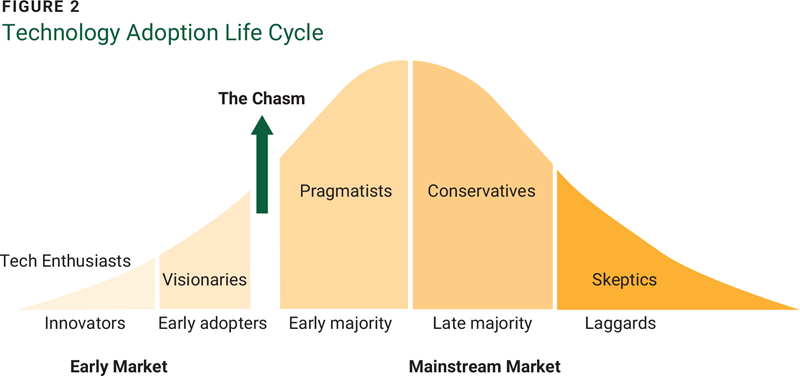
However, the journey toward innovation often involves crossing a chasm—a critical point where initial enthusiasm and early adoption must give way to widespread implementation and sustained success. The "chasm," introduced by Geoffrey Moore in his Technology Adoption Life Cycle model (figure 2),5 represents the gap between early adopters of new technology and the larger majority who are more cautious about embracing change. Similar to navigating a wormhole, crossing this chasm requires not only technological readiness but also a deep understanding of market dynamics, user behavior, and the ability to effectively communicate the value of innovation to a broader audience.
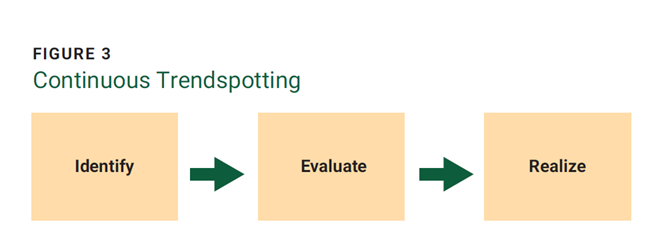
One effective approach to navigating the chasm is through continuous trendspotting (figure 3). This process involves three main steps:
- Identify—Organizations must continually scan the environment to identify emerging technologies and trends that could impact their operations. This requires staying attuned to the latest developments in the industry and understanding how they align with organizational goals.
- Evaluate—When potential trends are identified, they must be carefully evaluated for feasibility and relevance. This involves assessing risk and benefits, understanding the competitive landscape, and determining the potential return on investment.
- Implement—After evaluation, organizations must implement the most promising trends into the organization’s strategy and operations. This step ensures that the organization is equipped to leverage new technologies effectively and cross the chasm from early adoption to mainstream use.
Ultimately, the wormhole and chasm analogies in Interstellar serve as powerful metaphors for innovation in IT. They underscore the necessity of courage, strategic planning, adaptability, and thorough preparation in the face of uncertainty. By embracing these qualities, utilizing continuous trendspotting, and bridging the chasm between those who quickly adopt new technology and those who are more hesitant to embrace change, IT departments can navigate the ever-evolving technological landscape. This unlocks new opportunities and ensures that organizations remain at the forefront of progress.
Navigating AI With Ethical Principles: The TARS Framework
In Interstellar the AI robot TARS serves as a model of ethical behavior, embodying the principles of trustworthiness, transparency, and moral responsibility. TARS, equipped with a high level of intelligence and autonomy, consistently prioritizes the wellbeing and safety of the crew. Whether through humor settings that enhance human interaction or by providing honest assessments of mission risk, TARS exemplifies how AI can be an ethical and supportive companion.
One notable instance of TARS's ethical behavior is during a conversation with Cooper:
Cooper: “Were Dr. Brand and Edmunds ... close?”
TARS: “I wouldn’t know.”
Cooper: “Is that 90% or 10% ‘wouldn’t know’?”
TARS: “I also have a discretion setting.”
In this scene, TARS refuses to divulge personal information about Dr. Brand’s relationships. This demonstrates TARS’s respect for privacy and confidentiality, which are key elements of ethical AI.
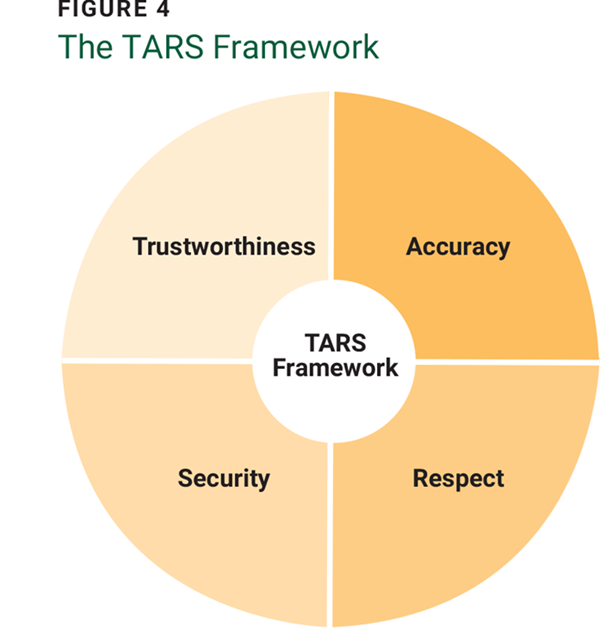
TARS exemplifies the core principles of ethical behavior, serving as a model for how AI systems should operate. Drawing inspiration from TARS, a framework was created to represent the key ethical AI principles that IT departments should integrate into their operations: Trustworthiness, Accuracy, Responsibility, and Security (TARS) (figure 4).
Trustworthiness
To enhance the trustworthiness of AI systems, several key practices should be implemented, including:
- Implement robust verification processes—Ensure that AI systems undergo rigorous testing and validation to confirm their reliability and effectiveness.
- Transparent communication—Provide clear information about AI capabilities and limitations to users, fostering transparency and trust.
- Feedback mechanisms—Establish channels for users to report issues or concerns with AI systems, and act on this feedback promptly.
Accuracy
To ensure the accuracy of AI systems, it is essential to adopt several best practices, including:
- Regular updates and maintenance—Continuously update AI algorithms and databases to ensure that they operate using the most current and accurate data.
- Data quality management—Implement strict data quality standards and procedures to ensure that the data used by AI systems is accurate and reliable.
- Performance monitoring—Regularly monitor and assess the performance of AI systems to identify and correct inaccuracies or biases.
Respect
To promote respect in AI systems, it is crucial to implement several important practices, including:
- Privacy protection—Implement strong privacy policies and technologies to protect user data from unauthorized access or misuse.
- Ethical guidelines—Develop and enforce ethical guidelines for AI development and use, ensuring respect for user rights and fairness in AI decisions.
- Inclusive design—Design AI systems with consideration for diverse user needs and perspectives, avoiding biases and discrimination.
Security
To enhance the security of AI systems, several key strategies should be implemented, including:
- Cybersecurity controls—Establish advanced cybersecurity controls, such as by implementing firewalls, conducting regular vulnerability assessments, and enforcing multifactor authentication (MFA), to protect AI systems and data from breaches, attacks, and other threats.
- Regular security audits—Conduct regular security audits and assessments to identify vulnerabilities and improve security protocols.
- Access controls—Enforce strict access controls to ensure that only authorized personnel can access sensitive AI systems and data.
By embedding ethical principles into AI development and deployment, organizations can foster trust and reliability in their AI systems, ensuring that they serve humanity's best interests.
Humanity's Odyssey: Adaptation in Challenging Environments
Inviting reflection on the resilience of the human spirit amid environmental adversity and existential risk, the film Interstellar presents a poignant exploration of humanity's capacity to adapt in the face of monumental challenges. Despite environmental degradation, the movie portrays how individuals and societies must innovate and endure to secure a future beyond crisis.
Drawing parallels to the fast-paced world of IT, where technological advancements evolve rapidly and dynamic environments demand constant adaptation, the narrative of Interstellar resonates deeply. Just as characters in the film navigate the unknowns of space and time, IT teams are tasked with navigating through complex digital landscapes, often requiring rapid innovation to stay ahead. The film's themes of innovation, collective problem solving, and ethical decision making mirror the challenges IT professionals face in safeguarding digital infrastructures and harnessing technology for positive impact.
One modern approach that exemplifies collective problem solving and adaptability in challenging environments is the swarming technique introduced in Information Technology Infrastructure Library (ITIL) 4. Swarming involves bringing together a group of experts from various domains to collaboratively address complex issues.6 While originally designed for incident resolution, this technique can be applied more broadly to enable IT teams to quickly adapt to sudden changes or unexpected challenges.
For instance, when IT teams face a critical system failure or need to rapidly implement a new technology, swarming allows for a dynamic and flexible response by leveraging diverse expertise within the organization. This method mirrors the collaborative efforts seen in Interstellar, where each character's unique skills and knowledge contribute to navigating the unknown and ensuring the success of their mission.
In a broader context, beyond mere problem solving, swarming can be a strategic approach to foster innovation and adaptability in various situations. Whether by integrating new technologies, responding to cybersecurity threats, or adapting to market changes, swarming enables IT teams to quickly and efficiently address challenges in a fast-paced, ever-changing environment. In this way, the resilience and adaptability showcased in Interstellar find their counterpart in the practices and methodologies that drive success in today’s IT landscape.
Conclusion
Interstellar serves as a profound reminder of humanity's enduring spirit and resilience. Emerging technologies such as AI, biotechnology, and space exploration promise to revolutionize industries and address global challenges. Yet, with these advancements come ethical complexities that require careful consideration and responsible stewardship.
As we navigate this era of innovation, we must resist inertia and embrace disruption with a commitment to ethical principles. Just as the characters in Interstellar confront the vastness of space with courage and determination, emerging technologies should be treated with curiosity, vigilance, and dedication to humanity’s well-being.
Endnotes
1 Interstellar, directed by Christopher Nolan, Paramount Pictures, 2014
2 Belkhir, L.; Elmeligi, A.; “Assessing ICT Global Emissions Footprint: Trends to 2040 & Recommendations,” Journal of Cleaner Production, vol. 177, 2018, p. 448-463
3 Forti, V.; Baldé, C. P.; et al.; The Global E-waste Monitor 2020: Quantities, Flows, and the Circular Economy Potential, United Nations University, International Telecommunication Union, International Solid Waste Association, 2020
4 HP, Go Beyond 2022 HP Sustainable Impact Report, 2022
5 Moore, G. A.; Crossing the Chasm: Marketing and Selling High-Tech Products to Mainstream Customers, HarperCollins, USA, 2002
6 AXELOS, ITIL 4 Create, Deliver and Support, TSO, The Stationary Office, United Kingdom, 2020
ABDELELAH ALZAGHLOUL | CISA, CISM, CGEIT, CRISC, ITIL 4 MASTER, ITIL 4 MP, ITIL 4 SL
Is an IT advisor with 20 years of experience in IT governance, service delivery, and IT transformation programs. He is experienced in the deployment of various IT governance frameworks and standards in the telecommunications sector. He is also a certified IT governance and service management trainer and a contributing reviewer for the ITIL 4 maturity model.