In an increasingly interconnected world, robust cybersecurity is paramount, and at its core lies effective authentication. As cyberthreats become more sophisticated and prevalent, the method by which users verify their identity and gain access to systems and data has never been more important. In traditional authentication, users verify their identity only at login (e.g., by entering a password or scanning a fingerprint), after which they gain continuous access until the session ends. This one-time verification model has well-known weaknesses. If an attacker obtains valid credentials or physically seizes a logged-in device, they can exploit the session without further checks. Studies show that a significant portion of users do not employ strong authentication on devices. For example, 16% of smartphone users do not protect their smartphones with any login method.1 Even when authentication is used, static mechanisms are susceptible to guessing, spoofing, and dictionary attacks after the initial login.2 Thus, there is a critical need for security measures that continue to verify user identity throughout a session, not merely at the start.
Adopting continuous authentication is essential to stay ahead of increasingly sophisticated cyberthreats.Continuous authentication (also known as active authentication) addresses this need by making identity verification an ongoing process. Instead of a single gate check, the system continuously monitors the user’s unique biometric and behavioral patterns at fixed intervals to ensure that the same authorized person is still present and using the system. If the system detects a deviation from the legitimate user’s profile or other risk signals, it can trigger reauthentication or session termination to mitigate threats. The goal is to promptly detect impostors who may hijack a session or device post-login, without unduly burdening the legitimate user with repeated manual logins.3
Traditional, static authentication methods are no longer sufficient. Adopting continuous authentication is essential to stay ahead of increasingly sophisticated cyberthreats. Failing to understand and implement this method could leave both individuals and organizations vulnerable to ongoing fraud, account takeovers, and data breaches.
Event-driven reauthentication combines the strengths of physiological biometrics with continuous monitoring of contextual signals.Continuous Authentication Mechanisms
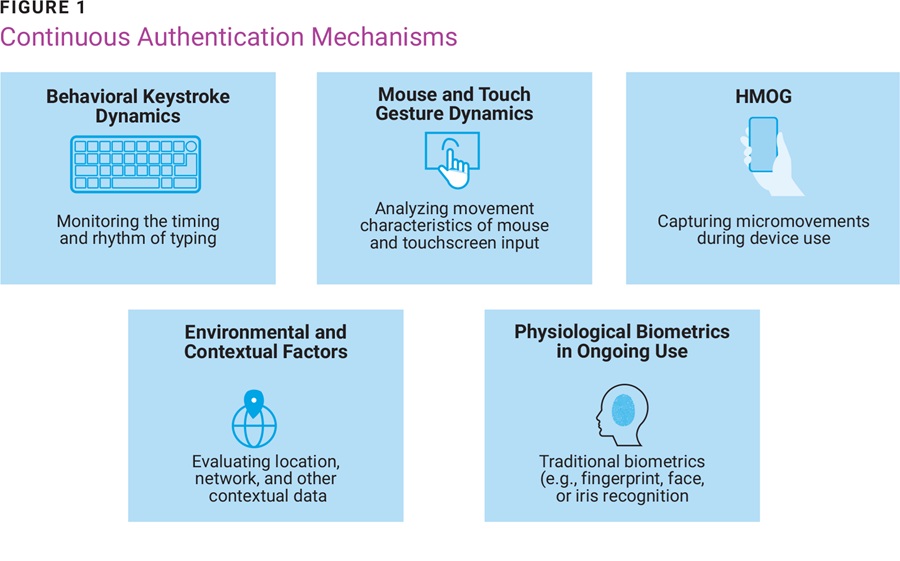
Continuous authentication systems rely on a range of biometric modalities and contextual signals to verify identity. Broadly, these mechanisms can be categorized into physiological biometrics (inherent physical traits) and behavioral biometrics (unique patterns in user behavior), with an increasing focus on the latter for continuous, passive monitoring.4 In practice, modern continuous authentication solutions often employ multiple modalities (multimodal biometrics) to improve reliability. Key mechanisms, depicted in figure 1, include:
- Behavioral keystroke dynamics—Monitoring the timing and rhythm of typing or touchscreen input. Every individual has a distinctive typing cadence and touch pattern. Continuous keystroke analysis can confirm if the current typing behavior matches the legitimate user's profile, both on physical keyboards and smartphone virtual keyboards. Keystroke dynamics, when combined with traditional methods, can reliably support user authentication, particularly for verification rather than identification.5
- Mouse and touch gesture dynamics—On a desktop, mouse movement characteristics (e.g., speed, curvature of cursor/pointer trajectories, click patterns) serve as behavioral biometrics,6 while on smartphones and tablets, touchscreen gesture traits (e.g., swipe velocity, pressure, gesture geometry) are used. These subtle interaction patterns are difficult for an impostor to mimic exactly. Machine learning (ML) models can learn the user’s typical mouse or touch behavior and detect deviations, enhancing security continuously
- Motion and gait analysis—The way a person moves while holding or carrying a device can act as an identifier. Built-in accelerometers and gyroscopes in smartphones enable continuous monitoring of gait (walking patterns) and other hand movements.7
- Hand movement, orientation, and grasp (HMOG) features—HMOG captures subtle micro-movements based on how the user holds and tilts a mobile phone. Experiments with HMOG demonstrate authentication equal error rates (EER) as low as ~7–10% by analyzing motion sensor data during routine mobile phone use. Notably, HMOG-based authentication became even more accurate when users were walking, as the distinctive gait-induced movements provided additional identity cues.8 This illustrates the promise of motion-based continuous biometrics on mobile devices.
- Environmental and contextual factors—Continuous authentication can incorporate contextual data such as the device’s location, the network being used, or time of access to assess whether the circumstances align with the legitimate user’s normal behavior. For example, if a user’s account suddenly initiates a session from a new country or at an unusual time, the system may flag the session as high-risk and prompt for reauthentication. Contextual authentication signals can be used in conjunction with behavioral biometrics to form a risk score for each active session (as seen in some enterprise user and entity behavior analytics [UEBA] systems).
- Physiological biometrics in ongoing use—Traditional biometrics such as fingerprint, face, or iris recognition are typically used for one-time login, but some applications have explored using them continuously or repeatedly.9 For instance, some laptops with infrared cameras perform periodic face verification and lock the system if the user’s face is no longer present. Similarly, continuous face recognition on mobile devices (using the front camera) or voice recognition during calls can, in theory, provide ongoing identity assurance. However, these approaches can be resource-intensive and potentially intrusive (e.g., a camera constantly watching the user), so they are less common than behavioral techniques. Instead, a common strategy is to transform an initial static biometric login into a continuous process by triggering it under certain conditions. The Smartphone Change of Possession Evaluation (SMARTCOPE) framework initially authenticates via a biometric (e.g., face recognition at login) and then triggers reauthentication events whenever a likely change of device possession is detected. This event-driven reauthentication combines the strengths of physiological biometrics with continuous monitoring of contextual signals.10
Benefits and Real-World Applications
There are two primary areas where continuous authentication is making an impact: enterprise security (including IT and financial services) and personal mobile device security.
Enterprise Security
Enterprise continuous authentication often involves monitoring an employee’s digital activities and comparing them to a baseline profile. For example, suppose an employee typically accesses the same set of applications each day. If suddenly the same authenticated user tries to access sensitive financial data it has never sought before, or issues atypical commands, the system can automatically challenge the user for additional verification or terminate the session. Similarly, if a valid login token is being used from an unusual location or on an unusual device, continuous authentication systems can detect the anomaly and respond. Such capabilities are increasingly integrated into identity and access management (IAM) platforms and security information and event management (SIEM) tools.11 They often work in tandem with multifactor authentication (MFA): MFA secures the initial entry and continuous behavioral monitoring secures ongoing access.12
For a practical example, consider the financial services industry, where user sessions remain active for long durations. Financial trading platforms may use keystroke dynamics and mouse behavior to continuously ensure that the logged-in trader is the same person, as any account takeover could lead to fraudulent transactions. Some organizations also deploy software agents on endpoints (user laptops/desktops) that collect behavioral signals (e.g., typing, application usage patterns) and send risk scores to a central server. If risk crosses a threshold, the system may increase authentication requests (e.g., ask for a fingerprint scan again) or log the user out. This approach can dramatically reduce the window of opportunity for an attacker who somehow gains access to a session. Continuous reverification ensures that perpetrators cannot stay in systems for long without being detected.13
Continuous authentication in enterprise settings is often coupled with user training and policy. Employees should be informed that their behavioral biometrics might be monitored as a security measure, and assurance must be given regarding privacy (to express that monitoring is done for security and not for surveillance of productivity, for example). When implemented thoughtfully, continuous authentication allows legitimate users to work seamlessly. They might not even notice it operating, all while significantly strengthening the organization’s security posture. Continuous authentication complements other defenses by adding an identity-centric monitoring layer on top of network and endpoint security.
Fighting Fraud
Continuous authentication plays a vital role in combating fraud by enabling real-time, dynamic risk assessment during a user’s entire session, rather than merely at the login stage. Traditional static controls such as passwords or even MFA often fall short against sophisticated schemes such as account takeovers and social engineering scams.14 These types of fraud may bypass initial authentication but reveal themselves through subtle changes in user behavior over time. Continuous authentication, especially when powered by behavioral biometrics, addresses this gap. It tracks and analyzes ongoing user interactions such as mouse movements, typing rhythm, swipes, and pauses to build a profile of normal behavior. This approach emphasizes the need for fraud tools that can establish a baseline of appropriate behavior and detect anomalies before a transaction is made or funds are lost.15
Moreover, continuous authentication reduces customer friction, a major challenge reported by 46% of surveyed institutions, by allowing low-risk sessions to proceed seamlessly while selectively applying friction only when the risk is high.16 This not only enhances security but also maintains a positive user experience, which is crucial in retaining customer trust.
In essence, continuous authentication transforms fraud defense from a static checkpoint into an adaptive, behavior-driven shield that evolves with each session, providing a proactive and customer-friendly layer of protection.
Key Challenges
Despite its advantages, continuous authentication introduces several challenges and concerns that organizations must address for it to be effective:
- Privacy and data protection—Continuous systems collect detailed behavioral data (e.g., keystrokes, movement) that could reveal sensitive information, raising privacy concerns.17 Improper handling of this data can lead to misuse or unauthorized profiling, the effects of which can be especially grave due to regulations such as the EU General Data Protection Regulation (GDPR) and US State of California Consumer Privacy Act (CCPA).18 Organizations must ensure minimal, transparent data collection and strong encryption to safeguard user information. Techniques such as on-device processing, where data collection, feature extraction, and verification all happen on the user’s device, can also mitigate risk.
- Accuracy and reliability—No biometric system is flawless. Continuous authentication, especially through behavioral biometrics, can face errors due to stress, fatigue, or contextual changes (e.g., a user typing slower when tired). This may lead to false rejections or false acceptance, which can frustrate users or compromise security. Balancing accuracy and usability is challenging and requires adapting to long-term behavior changes, with ongoing research aimed at improving reliability.
- Performance and scalability—Continuous authentication demands frequent data sampling and real-time analysis, which can drain device resources. Optimizing algorithms and utilizing edge computing are key to addressing these performance concerns.19 In enterprise environments, scalability is crucial, as high numbers of users require robust infrastructure to process high-frequency data streams efficiently.
- User acceptance and ethical concerns—Users may reject continuous monitoring if it feels invasive or if data collection is unclear. Gaining trust through transparency and informed consent is essential. Furthermore, these systems must avoid bias, especially when they fail to recognize behaviors of certain demographic groups or individuals with disabilities. Ethical concerns, including fairness, can impact widespread adoption, so continuous evaluation and improvements are necessary
Future Trends and Research Directions
Continuous authentication is steadily maturing into practical technology. Looking ahead, several trends and opportunities are likely to shape the next generation of continuous authentication systems:
- Advanced multimodal biometrics—Future systems will integrate multiple biometric and contextual factors for enhanced accuracy and resilience, combining data from various sensors such as posture, heart rate, and wearables.20 This approach will leverage Internet of Things (IoT) ecosystems for continuous identity validation.
- AI and adaptive learning—Deep learning and adaptive systems will refine behavior models and reduce error rates, allowing continuous updates based on evolving user behavior. However, challenges around AI interpretability and adversarial attacks remain.21
- Energy-efficient and edge computing solutions—Research will focus on reducing the energy demands of continuous authentication, with techniques such as federated learning and offloading computations to cloud or edge servers. This will improve battery life while maintaining privacy.22
- Continuous authentication in zero trust architectures—With the rise of zero trust security models, continuous authentication will become standard in enterprises. It will integrate with other security protocols, providing real-time risk assessments across networks.23
- Ethical and fairness considerations—Ensuring fairness and mitigating bias in biometric models is crucial, especially for diverse populations. Privacy-preserving data techniques will allow improvements without compromising individual data. Regulatory guidance will also be key to ensuring compliance and fairness.24
- New domains and modalities—Continuous authentication may expand into new areas such as extended reality (XR), automotive security, and healthcare, where user identity must be continuously verified during sensitive transactions. Each domain presents unique challenges and opportunities for research and development.25
Conclusion
Continuous authentication represents a shift in identity security, from one-time validation to ongoing verification. By leveraging behavioral biometrics and contextual data, it provides a dynamic and adaptive layer of defense that is well-suited to the modern threat landscape of persistent attacks and hybrid work environments. The benefits of stronger security and potentially better user experience make a compelling case for this approach, but there remain challenges of privacy, accuracy, performance, and user acceptance.
Looking forward, continuous authentication is poised to become more ubiquitous and intelligent. With ongoing research into energy-efficient methods, richer biometric modalities, and integration into zero trust frameworks, it is likely that within a few years, continuous identity verification will be an invisible yet trusted guardian across many devices and applications. Embracing this approach will help organizations and individuals stay one step ahead of adversaries by not only locking the front door but constantly patrolling the halls for any sign of impostors. The journey toward fully realizing continuous authentication will require interdisciplinary effort spanning cybersecurity, ML, human–computer interaction, and privacy law, but the end result promises a significant leap forward in securing digital identities in an ever-connected world.
Endnotes
1 Mcclain, C.; Faverio, M.; et al.; “How Americans Protect Their Online Data,” Pew Research Center, 18 October 2023
2 Wang, X.; Yan, Z.; et al.; “Attacks and Defenses in User Authentication Systems: A Survey,” Journal of Network and Computer Applications, vol. 188, 2021
3 Poojara, K.; “Continuous Authentication Explained: Real-Time Security Beyond Login,” Krutik Pooja Blog, 22 July 2018
4 Poojara, K.; “Continuous Authentication Explained”
5 Finnegan, O.; White, J.W.; et al.; “The Utility of Behavioral Biometrics in User Authentication and Demographic Characteristic Detection: A Scoping Review,” Systematic Reviews, vol. 13, iss. 1, 2024, p. 61
6 Dave, R.; Handoko, M.; et al.; “From Clicks to Security: Investigating Continuous Authentication via Mouse Dynamics,” arXiv, 2024
7 Poojara, K.; “Continuous Authentication Explained”
8 Sitová, Z.; Šeděnka, J.; et al.; “HMOG: New Behavioral Biometric Features for Continuous Authentication of Smartphone Users,” IEEE Transaction on Information Forensics and Security, vol. 11, iss. 5, May 2016, p. 877–892
9 Chhibbar, L.; Patni, S.; et al.; “Enhancing Security Through Continuous Biometric Authentication Using Wearable Sensors,” Internet of Things, vol. 28, 2024
10 Cariello, N.; Levine, S.; et al.; “SMARTCOPE: Smartphone Change of Possession Evaluation for Continuous Authentication,” Pervasive and Mobile Computing, vol. 97, 2024
11 Sitová, Z.; et al.; “HMOG: New Behavioral”
12 Yakushkin, V.; “Rethinking IAM: What Continuous Authentication Is and How it Works,” Syteca, 7 December 2022
13 Sitová, Z.; et al.; “HMOG: New Behavioral”; Yakushkin, V.; “Rethinking IAM”
14 BioCatch, 2021 Fraud Transformation Survey: Detecting and Preventing Emerging Schemes, 2021
15 BioCatch, 2021 Fraud Transformation Survey
16 BioCatch, 2021 Fraud Transformation Survey
17 Ayeshwarya, S.; John Singh, K.; “A Comprehensive Review on Secure Biometric-Based Continuous Authentication and User Profiling,” IEEE Access, vol. 12, 2024, p. 82996–83021
18 Regulation (EU) 2016/679 of the European Parliament and of the Council of 27 April 2016 on the protection of natural persons with regard to the processing of personal data and on the free movement of such data, and repealing Directive 95/46/EC (General Data Protection Regulation [GDPR]); California Privacy Protection Agency (CPPA), “California Consumer Privacy Act Regulations,” USA
19 Liang, Y.; Samtani, S.; et al.; "Behavioral Biometrics for Continuous Authentication in the Internet-of- Things Era: An Artificial Intelligence Perspective," IEEE Internet of Things Journal, vol. 7, iss. 9, 2020, p. 9128–9143
20 Acar, A.; Aksu, H.; et al.; "A Usable and Robust Continuous Authentication Framework Using Wearables," IEEE Transactions on Mobile Computing, vol. 20, iss. 6, 2021, p. 2140–2153
21 Dong, Q.; Amariucai, G.; et al.; “Improving Behavior-Based Authentication Against Adversarial Attack Using XAI,” arXiv, 2024
22 Albasheer, A.; Abdallah, M.; et al.; “Fine-Grained Data Selection for Improved Energy Efficiency of Federated Edge Learning,” arXiv, 2021
23 Wang, R.; Li, C.; et al.; “Zero-Trust Based Dynamic Access Control for Cloud Computing,” Cybersecurity, vol. 8, iss. 12, 2025
24 Prakasha, K.; Udaya, S.; “Privacy-Preserving Techniques in Biometric Systems: Approaches and Challenges,” IEEE Access, 2025
25 Agarwal, A.; Ramachandra, R.; et al.; “Biometrics in Extended Reality: A Review,” Discover Artificial Intelligence, vol. 4, iss. 81, 2024
KRUTIK POOJARA | CEH, CISSP
Is a senior security consultant at Verizon, where he leads mobile application security, application programming interface (API) security, and artificial intelligence (AI) security initiatives across dozens of high-impact products. With more than a decade of experience in cybersecurity, he has contributed to cutting-edge research in privacy and secure software development, earning national recognition and multiple academic and industry awards. Poojara is also an active member of the global cybersecurity community as an ISACA® contributor, Institute of Electrical and Electronics Engineers senior member, and mentor for emerging professionals.
MANSI POOJARA
Is a software developer at Google X with a strong background in full-stack development and secure software engineering. She has previously contributed to high-impact projects at Tata Consultancy Services and startups such as Revamp Systems, where she focused on building scalable software as a service (SaaS) platforms and integrating security best practices into product design. Poojara is particularly passionate about advancing security research at the intersection of software engineering and emerging technologies.